



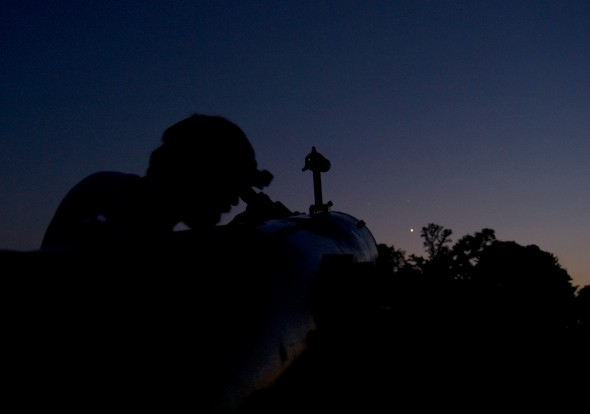
Pat Craig peers through his telescope at Venus in 2010. (News archive photo by Aaron Zaremsky)
Down to Earth | Light at night comes at cost
- Published: April 17, 2026

The following information is from DarkSky International, submitted by the YS Habitat Team.
Over the past 100 years, humans have transformed the night, erasing the natural darkness with which we evolved. While artificial light at night is crucial to our modern world, it comes at a cost. Artificial light has contributed to light pollution which is increasing at a global average rate of 10% a year.
Light pollution includes components of:


• Glare — excessive brightness that causes visual discomfort;
• Sky glow — brightening of the night sky over inhabited areas;
• Light trespass — light falling where it is not intended or needed; and
• Clutter — bright, confusing, and excessive groupings of light sources.
Growing scientific research indicates that artificial light at night has detrimental effects on human health and well-being. Circadian disruption occurs when our internal clock is out of sync with the day-night cycle. Circadian disruption has been linked to an increased risk of obesity, diabetes, mood disorders, reproductive problems and cancers.
Plants and animals also depend on natural light cycles to govern life-sustaining behaviors such as reproduction, nourishment, sleep and protection from predators. Scientific evidence suggests that artificial light at night has deadly effects on many creatures, contributing to the decline of biodiversity worldwide. Artificial lights can cause migrating birds to wander off course toward dangerous nighttime landscapes and cities. Millions of birds die colliding with needlessly illuminated buildings and towers every year.
We are just starting to understand the effects of artificial light on wildlife. Each year, new research adds more wildlife to the list of affected animals, including monarch butterflies, moths and other insects, bats, owls and even aquatic species.
DarkSky estimates that 30% of all outdoor lighting in the U.S. is also wasted, mostly due to unshielded or excessively bright lights. This adds up to $3.3 billion dollars annually. Installing quality outdoor lighting could cut energy use by 60% to 70%.
In the U.S. alone, unnecessary lighting produces 21 million tons of carbon dioxide each year — 875 million trees would need to be planted annually to offset this waste.
Studies like one out of the city of Chicago are revealing that brighter light does not always equate to increased safety. Poorly designed, misdirected and ineffectively shielded light can actually cause glare and shadows, while overly bright lights can potentially reveal more potential targets for crime. Outdoor lighting should be fully shielded and directed downward where it is needed. Fully shielded fixtures can provide the same level of illumination on the ground as unshielded ones, but with less energy and cost.
Unnecessary indoor lighting — particularly in empty office buildings at night — should be turned off, preventing leakage of that light into the night sky. Warm-light LED and compact fluorescent bulbs can help reduce energy use and protect the environment.
Dimmers, motion sensors and timers can help to reduce average illumination levels and save even more energy.
During spring and fall bird migration periods, close curtains or reduce light on second-story floors in residential homes at night, and do not shine spotlights upward toward the sky.
For more information, visit local chapter DarkSky Ohio’s booth at the YS Earth Day & Community Habitat Celebration on Sunday, April 26, 1–4 p.m. on the lawn of the John Bryan Community Center.
The Yellow Springs News encourages respectful discussion of this article.
You must login to post a comment.
Don't have a login? Register for a free YSNews.com account.






No comments yet for this article.