



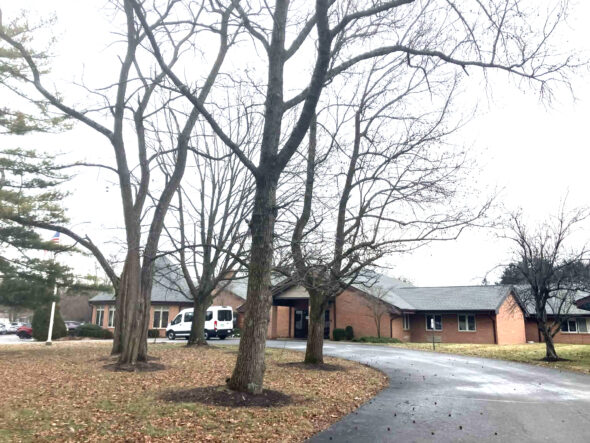
Friends Care Community at 150 E Herman St, Yellow Springs. (Photo by Reilly Dixon)
Friends Care Community looks to the future
- Published: February 20, 2026

With longtime Executive Director Mike Montgomery having retired Jan. 9, Friends Care Community is stepping into a transitional period — one in which the nonprofit long-term care provider is asking itself, and the wider Yellow Springs community: How can Friends Care survive and thrive into the future, and what role will the community play in that effort?
The shift comes as Friends Care faces the same financial and structural pressures affecting long-term care facilities nationwide, but often intensified for nonprofit communities that are independent and not part of larger managed care organizations. Board President James Duffee told the News this month that Friends Care’s coming months will be focused on reassessing its services and, hopefully, deeper community engagement.
Duffee, a retired pediatrician who joined the Friends Care board a little over two years ago and became its president shortly thereafter, said the warning signs were already apparent when he arrived.


“When I joined the board, it was very clear that there was a developing financial crisis,” Duffee said. “But a crisis is an opportunity as well.”
Like many long-term care providers, Friends Care has been affected by payment rates, including Medicare and Medicaid reimbursements, that have failed to keep pace with the cost of care; as the News reported last year, data from the CDC and health policy organization KFF reveal that Medicaid covers more than 60% of residents in nursing homes, about 20% of people in assisted living and more than half of all long-term care residents in the U.S. Duffee said rising costs and funding shortfalls have affected “all of healthcare, but long-term care in particular.”
According to a 2024 report from the American Health Care Association and National Center for Assisted Living, since 2020, more than 62,000 nursing home beds have been lost nationwide, and at least 774 nursing homes have closed, displacing 28,421 residents. In Ohio alone, 17 nursing homes closed in fiscal year 2023. Nationwide, 46% of nursing homes are limiting new admissions and 57% have wait lists.
Friends Care’s long mission of operating as an independent nonprofit, Duffee said, means the organization can’t respond to ongoing pressures by spreading costs across multiple sites or subsidizing losses in one area with profits from another, as would be the case if it were part of a large corporate health system. Adding to the strain, Duffee said, is managed care, an insurance model designed to control costs by steering patients within specific provider networks.
Particularly with regard to rehabilitation — a service offered by Friends Care — Duffee said managed care often means patients must actively request to recover at Friends Care rather than being referred there automatically, because corporate healthcare systems prefer to use their own, in-network, rehab units.
Duffee said part of the challenge is “right-sizing” the services Friends Care offers. In skilled nursing, census levels have lagged behind capacity; the facility currently operates 59 skilled-nursing beds, including 16 for rehabilitation, but Duffee said those beds are often underfilled. At the same time, Friends Care maintains strong demand for assisted living and independent living, with active wait lists for both.
That contrast prompted the organization to ask what services it should prioritize going forward. Friends Care circulated an informal community survey in late 2023, receiving about 100 responses. Duffee emphasized that it was a “survey of convenience,” not a scientific sample, but said the responses revealed some trends.
“What was important for the community were things like more independent-living units, more assisted-living units, memory care,” Duffee said. Respondents also expressed interest in home-based services for those who prefer to age in place, including home care and therapy programs.
“In general and particularly regarding memory care, in the words of one of the survey respondents, ‘the need will mushroom,’” Duffee said.
The Friends Care board also hired PMD Advisory Services to conduct a market feasibility analysis, aiming to understand what expanding services might look like. The study echoed feedback from the community, finding demand in the wider Miami Valley for additional independent living, assisted living and assisted living memory care.
The PMD study rated the Friends Care campus as a good location for continued investment, citing municipal utilities, zoning, vehicle access, proximity to Miami Township Fire-Rescue and YS Police Department, proximity to parks and recreation and churches and neighborhood safety as its strengths. It also identified weaknesses in the site, including limited public transit access and less-than-optimal proximity to a full-service hospital.
Friends Care currently maintains 11 independent-living residences and 20 assisted-living apartments. PMD recommended that Friends Care offer 20 additional independent-living duplex residences, 12 additional assisted-living beds and 24 assisted-living memory-care beds.
Another PMD study, focused on skilled nursing, recommended a shift toward a for-profit model — an option Duffee said the board rejected.
“We want to remain independent and remain community-based and not for profit,” he said.
The question, Duffee said, is how to move forward without losing that identity — and how to pay for it.
“I believe that can happen, but the pathway isn’t clear at this point, and we definitely need community support to do that,” Duffee said.
To help navigate that pathway, Friends Care contracted with AQORD, a health and human services organization rooted in Quaker and Mennonite traditions; Duffee said the choice of AQORD reflects the board’s commitment to Quaker values, which have informed the mission of Friends Care since it opened in 1980.
In working with AQORD, Friends Care brought in interim administrator Sean Riley to step in following the retirement of Mike Montgomery as executive director. Riley is employed by AQORD and will work with Friends Care on a short-term basis while the board conducts its own search for a permanent executive director.
“[Riley is] a consultant to the board,” Duffee said. “He’s not just putting his credentials on the wall and keeping the lights on.”
Riley is expected to evaluate internal processes and help Friends Care assess new service lines, including whether home-based programs and expanded memory-care options could be developed within Friends Care’s capacity.
“I don’t know what I don’t know,” Duffee said. “So Sean’s going to tell us what we don’t know.”
Any future expansion, Duffee said, will require significant investment, first through renovation of existing space, and later through potential additional units and programming. Friends Care has seen a modest uptick in donations over the past year, Duffee said, but large-scale, dedicated fundraising is on the horizon.
“We’re going to need to do a capital campaign within the next few years,” he said. “But what I’m interested in right now is social capital rather than financial capital. We need people’s awareness.”
Ultimately, Duffee said, Friends Care’s future will depend on whether the community sees the facility as both an asset and a shared responsibility.
“Very frankly, we need to make sure that Friends Care is here in five years, in 10 years, in 15 years,” he said. “We want to remain not for profit. We want to remain independent. We want to remain community-based — but that means the community needs to be engaged more.”
The News will continue to follow up with Friends Care Community as it develops plans for the future.
The Yellow Springs News encourages respectful discussion of this article.
You must login to post a comment.
Don't have a login? Register for a free YSNews.com account.






No comments yet for this article.