



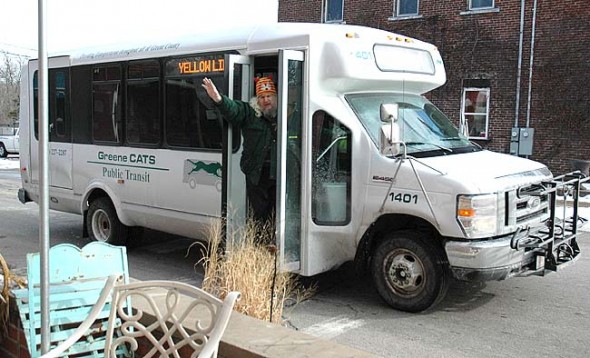
Villager Gene Lohman, hopping aboard the bus in 2015. (News archive photo by Lauren Heaton)
Greene CATS proposes bus route cuts, fare hikes
- Published: April 21, 2026

Proposed changes to Greene CATS are on course to reshape public transit across the county — including eliminating the Flex Route that currently connects Yellow Springs to Xenia and Fairborn.
Under a revised service plan announced by the Greene County Transit Board in late March, beginning July 1, the system would eliminate all five of the county’s Flex Routes, which run on fixed paths with scheduled stops. Locally, Flex Route stops have been operating at YS Library, the Bryan Center and the intersection of Dayton and W. Limestone streets since 2013.
Flex Routes account for about 40% of all rides provided by Greene CATS, according to Transit Director Ken Collier.


In addition to eliminating those routes, Greene CATS would reduce weekday service hours from 6 a.m.–10 p.m. to 6 a.m.–6 p.m. Two existing scheduled ride runs would be converted into same-day, on-demand service within limited zones — one serving Fairborn and North Fairfield, and another serving Xenia and Wilberforce — in an effort to partially offset the loss of Flex Routes.
Though the on-demand service won’t cover Yellow Springs, village riders will still have the option to schedule rides with Greene CATS at least two business days in advance. Rides can be scheduled by calling 937-708-8322 Monday–Friday, 8 a.m.–4 p.m.
The plan also calls for a change to fare structure. Instead of the current one-way, flat adult rate of $4 for in-county and $8 for out-of-county trips, one-way fares would move to a per-mile model: $5 for trips up to 10 miles, $10 for 10–20 miles and $20 for trips exceeding 20 miles. Children’s fares would increase from $1 to $2 per one-way trip, and elderly and disabled riders, who currently can apply for a half-fare program, would pay the adult rate.
Greene CATS officials are seeking public input on the proposal before finalizing changes later this month. Public meetings were held in Fairborn and Xenia last week; additional written comments will be accepted through April 23.
About two dozen people filled the media room at the county’s Department of Job and Family Services on April 10 to hear and give feedback about the proposed plan. Collier told attendees the proposed reductions are driven by a combination of declining funding and rising costs.

Transit Director Ken Collier met with a room of about two dozen county residents in Xenia last week to discuss a proposed reduction in Greene CATS services and fare increases due to diminished federal and state funding. (Photo by Lauren “Chuck” Shows)
“We have had about 16% reduction in our federal funding,” Collier said, adding that Greene CATS has also seen a significant increase in operating costs, including an 18% jump in its most recent service contract.
Collier said the funding loss is tied in part to the end of pandemic-era federal support and a shift in Greene County’s classification from an urban to a largely rural service area following the most recent census. That reclassification changed how federal transit dollars are allocated, reducing available funding and limiting how funds can be used across different parts of the county.
“We’re trying to bring our service to the level of our funding and provide as much and the best service we can with the funding that we have,” he said.
Collier added that Greene CATS has been relying on reserve funds since 2024 — at a rate of roughly $90,000 per month — to maintain current service levels, which he said is not sustainable for the agency in the long term.
“I wish I had better news,” he said.
Collier also explained that Greene CATS does not receive funding from a dedicated local levy or general county tax revenues. Instead, the program relies on a mix of federal and state grants, passenger fares and contracts to provide services for agencies such as the Greene County Board of Developmental Disabilities and the Department of Job and Family Services. Those contract services, Collier added, help provide the required local match for federal funding.
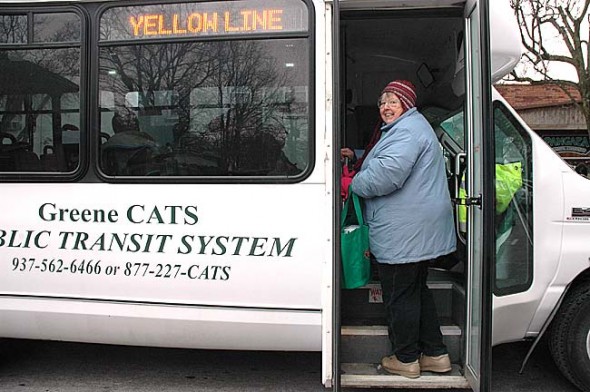
Barbara Mann hailed down a Greene CATS Yellow Line bus in front of Tom’s Market in 2013, on the line’s its first day of service to the village. (News archive photo by Diane Chiddister)
Meeting attendees raised concerns about how the proposed changes would affect access to work, medical appointments and daily needs, particularly for those without access to a car. Several questioned the elimination of Flex Routes, which connect rural towns, including Yellow Springs, to larger nearby communities with more amenities. Others expressed concern about the loss of evening service, which could impact workers with shifts ending after 6 p.m.
One attendee described relying on Greene CATS to commute to work and said the earlier cutoff would make it difficult to maintain employment. Another questioned whether the new model would reliably meet riders’ needs, citing experience with long waits on circuitous routes via scheduled rides, which are often shared between multiple riders.
Cost increases were also a point of concern, with attendees questioning whether the per-mile rates would be affordable for regular use by low-income residents, especially for longer trips.
Collier acknowledged the challenges, noting that the system is attempting to balance service levels with available resources.
“We have a challenge of having to … right-size our service to the size of what we can do,” he said. “A challenge of the Midwest is that our densities are a lot lower.”
Collier said some aspects of the plan could still be adjusted based on public feedback before final approval, though he said it’s unlikely the Flex Routes will be restored without a significant increase in funding. To that end, he added, it’s also unlikely that funding for public transport in the county will increase without state and federal support. When asked what residents can do to advocate for more transit funding, Collier recommended reaching out to legislators.
“Contact your state representatives here in this area,” he said, noting that increased support for required matching funds, in particular, would be critical to expanding service.
Written public comments on the proposed plan will be accepted through April 23 via email at info@greenecats.org or by mail to the Greene CATS office, 2380 Bellbrook Ave. Suite A, Xenia, OH, 45385.
The Yellow Springs News encourages respectful discussion of this article.
You must login to post a comment.
Don't have a login? Register for a free YSNews.com account.





No comments yet for this article.