






Packing up the plants: After three years of business in downtown Yellow Springs, Tweedle D’s closed their doors last week following the full implementation of Senate Bill 56, which prohibits the sale and possession of intoxicating hemp products — such as CBD- and THC-infused candies, salves, drinks and more. Pictured above is proprietor Shane Ayrsman packing up his store. (Photo by Reilly Dixon)
Village businesses reel from intoxicating hemp ban
- Published: April 7, 2026

Ohio’s new cannabis and hemp laws, embedded in Senate Bill 56, which bans the sale and possession of intoxicating hemp products, took effect Friday, March 20.
Under the legislation THC- and CBD-infused seltzers, candies and plant parts can only be sold through licensed dispensaries regulated by the Ohio Division of Cannabis Control.
The whole of Senate Bill 57 became law after Ohioans for Cannabis Choice failed to collect more than 248,000 signatures from at least 44 of Ohio’s 88 counties to get a referendum on the November ballot to repeal Sections 1, 2 and 3 of the bill that Gov. DeWine signed into law in December.


Despite considerable efforts across the state, and even a local push in Yellow Springs, the signature campaign for a referendum fell short.
Now, the village’s headshops and smoke stores have removed all intoxicating hemp products from their shelves — in some cases, paring down their largest revenue streams. Bars and gas stations can no longer stock cannabis drinks.
At Tweedle D’s, the front door is locked for good. A sign reads “Closed indefinitely due to Senate Bill 56. Thanks DeWine!”
The News caught up with Tweedle D’s co-owner and villager Shane Ayrsman as he was packing up his plants and taking down his Xenia Avenue storefront.
Ayrsman said he was devastated by the implementation of SB 56, but not surprised.
“It’s always been a continual struggle for all factions in the cannabis industry, and I think there always will be until there’s some national recognition,” he said. “Until then, Ohio needs to get it together.”
A village native and Antioch alum, Ayrsman moved back Yellow Springs three years ago with his wife, Sarah DeVore, to open up a hemp retailer to help their neighbors find relief from physical pain, anxiety and other ailments from their products — which were largely derived from hemp that Ayrsman and DeVore grew themselves on their farm in Oregon.
Since 2023, Tweedle D’s operated in full compliance with state law, selling tinctures, topicals, pet products, drinks, edibles, smokeables and more. Only those 21 and older were allowed in the store.
At the time of its closure, the downtown store had nine employees: “People who are now back out there in the job market, and people who have since told me that they can only make half the wages they made here,” Ayrsman said. “As a result, they’re saying they might not be able to live in Yellow Springs anymore. So, in a way, this law is contributing to the gentrification of this town.”
Though Tweedle D’s sold a variety of items, Ayrsman said they were all ancillary to the THC- and CBD-derived products that lined his shelves. He said he could have continued to operate his shop, but said it would have been like “your favorite pizza parlor that made the world’s greatest pizza suddenly selling ‘take-and-bakes.’” So, he opted to close.
Though Ayrsman bemoaned the loss of Tweedle D’s, he said it’s not over for him and DeVore’s downtown presence, let alone their work in the cannabis industry. The owner of their building at 255 Xenia Ave. is letting them continue renting the commercial space, giving Ayrsman and DeVore the time they need to come up with a new business plan — perhaps one that veers back to selling helpful cannabis products, provided different state politics in the future.
“So, we’re in a good position with our farm and our other store [in Florida],” he said. “While we feel this greatly, we may feel it a bit less than others. We’re being given the chance to have another stab at it, and we have a buffer period to think about how to do that.”
A few downtown blocks away, the staffers at The Joynt on Dayton Street are also feeling the effects of SB 56.
Equal parts head shop and consignment boutique, The Joynt opened its doors last summer in the space that previously housed The Import House. According to co-owners Dan Lukasavitz and Rocky Brennan, a large portion of their shop’s revenue disappeared overnight from last week’s full passage of the law.
“It’s left a lot of space in the shop feeling bare, empty and, honestly … a little sad,” the couple wrote to the News in an email.
As the News wrote when The Joynt opened, the shop’s pièce de résistance is its wide-ranging selection of hemp-derived flower buds imbued with tetrahydrocannabinolic acid, or THCA — a kind of cannabinoid not dissimilar from traditional marijuana, but until last week, legal to sell outside dispensaries.
“Since Friday, [March 20] our foot traffic has dropped off significantly,” Lukasavitz and Brennan wrote. “Our front door used to ring constantly throughout the day, and now it’s a pretty rare occurrence. There’s no clean way to spin that.”
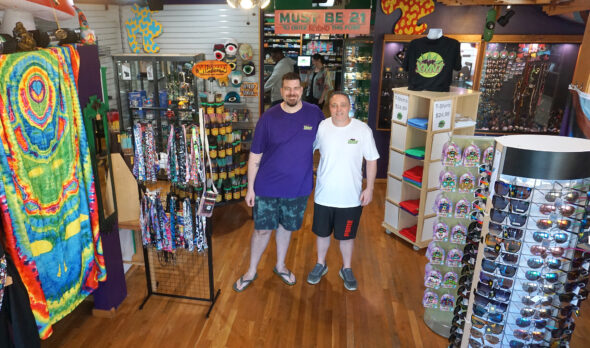
Yellow Springs newcomers Dan Lukasavitz, left, and Rocky Brennan opened The Joynt last year — the village’s newest head shop and hippie boutique — at 124 Dayton St., the storefront that housed the Import House for 39 years until its closure earlier last spring. (Photo by Reilly Dixon)
They continued: “What’s hitting us the most, though, is our regulars. A lot of people weren’t just stopping in for fun; they were using these products to help manage sleep, anxiety, pain … real, everyday stuff. And now they’re kind of left without many options.”
The pair said they have no immediate plans to close up shop — they’re now reliant on glass, art and apparel sales. They’re also making adjustments to operations — reducing hours, reworking staffing and “taking a hard look at where we can cut and tighten things up just to stay afloat.”
“If there’s one thing we wish people understood,” they wrote, “it’s that this isn’t just as simple as ‘just don’t sell it anymore.’ This impacts small businesses in a big way, and it cuts off access for people who found real value in these products. There’s a human side to it that gets overlooked.”
Back on Xenia Avenue, but a bit down the road from Tweedle D’s is The Smoking Octopus, which has been selling hookahs, glassware and other smoking-related products for more than a decade out of the iconic brick Oten Gallery.
Owner Sarah Webb said that, while The Smoking Octopus won’t close due to the implementation of SB 56 forcing her to take her hemp products down, it nevertheless cuts into her margins. But more than that, like the guys at The Joynt, Webb said she’s worried about some of her customers.
“We see a lot of people who use these products as a replacement for alcohol and dangerous substances,” she said. “So some people have said to me that they’re worried about losing their decades of sobriety over this decision, and hearing stories like this is just so heartbreaking.”
Like all the others, Webb said she sees SB 56 as an affront not only to small businesses like hers — “the ones doing it the right way and following all the rules,” she said — but also an affront to the will of the people.
Webb referenced the passage of Issue 2 in the Nov. 2023 statewide election, which legalized the recreational use of marijuana for adults aged 21 and over, and then the following August, recreational sale. Fifty-seven percent of Ohio voters approved Issue 2.
Beyond prohibiting the sale and possession of intoxicating hemp products, HB 56 rolls back several other cannabis industry regulations.
Now, there is a statewide cap of 400 dispensaries, which can be no closer to schools, playgrounds and churches than 500 feet. It also bans public smoking and vaping — now classified as a misdemeanor offense — and requires cannabis products to be stored in a vehicle’s trunk while driving.
“This isn’t progress,” Webb said. “We’re backtracking. I don’t feel like the governor understands the gravity of the decision that he made.”

Sarah Webb of the Smoking Octopus in 2015. (News archive photo)
Last October, before his signing of SB 56 into law, Gov. DeWine declared “an adulterated consumer product emergency” for items containing intoxicating hemp, as an attempt to “get the products off the streets” and “to protect our children,” as he said at an Oct. 8 press conference.
During the conference, DeWine held up a box of THC-infused gummies designed to emulate the appearance of a well-known candy brand that, as DeWine indicated, could appeal to under-age consumers.
According to Ohio Poison Control, exposures to delta-8-THC and delta-9-THC among those ages 19 or younger increased from 419 in 2021 to 994 in 2024, with more than half of all cases involving children ages five and under.
Those with whom the News spoke were unconvinced by DeWine’s rationale for signing the bill.
“This is about respecting the will of the voter,” Ayrsman said of Issue 2’s 2023 passage. “We said ‘yes’ overwhelmingly. This now is about lobbyists for big businesses and steamrolling small businesses, which creates this disparity between people who want and need cannabis and those who grow it.”
The Yellow Springs News encourages respectful discussion of this article.
You must login to post a comment.
Don't have a login? Register for a free YSNews.com account.





No comments yet for this article.