




Columbus-based Windsor Companies aims to demolish the derelict former Student Union at
Antioch, and in its place on the 2.16-acre site, build two three-story apartment buildings. A rendering of one is shown here. (Submitted photo)
Windsor granted delay in final apartment plans
- Published: April 14, 2026

At the most recent regular Village Council meeting, Monday, April 6, a representative from Columbus-based real estate developer Windsor Companies — the company behind the proposed apartment units on former Antioch College properties — returned again to Council chambers, this time with a straightforward request.
Windsor needs more time.
Specifically, Windsor sought from Council up to another year to submit final development plans for their proposed planned unit development, or PUD, for the apartments.
As previously reported in the News, Windsor purchased the former Antioch student union building in 2024 for $500,000 with plans to demolish the derelict building, and in its place on the 2.16-acre site, build two three-story apartment buildings, with 48 rental units each. At the same time, the Charles F. Kettering building was, and still is, under contract; Windsor intends to install 43 senior-focused rentals there.
Last July, Village Council voted unanimously to approve Windsor’s preliminary plat plans to pursue these intentions.
Per the Village zoning code, developers are granted a year to author and submit for approval final plat plans upon the approval of preliminary plans. Final plat plans must incorporate results from traffic, parking and pedestrian impact studies; state requirements for sound, accessibility and sustainability; architectural reviews; and engineering recommendations.
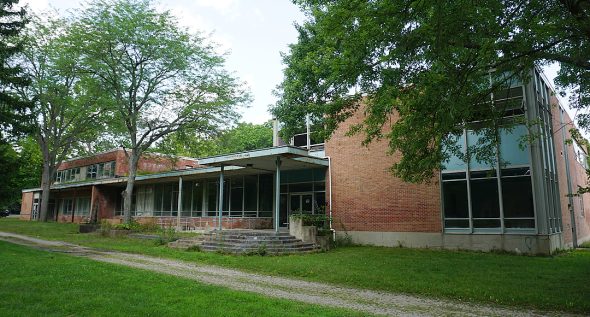
With plans to demolish the site, Columbus-based Windsor Companies purchased the Antioch College Student Union for $500,000. The developer plans to erect efficiency and one- and two-bedroom apartments in its place. (Photo by Reilly Dixon)
“Our intention is not to delay our submission any longer than is absolutely necessary,” Alfieri said at Monday’s meeting. “We continue to work to finalize our comprehensive development plan with as much speed as practical. Having said that, the final development plan involves coordination among many third parties, including our architect, engineers, several different consultants and designers. We continue to refine our plans with these groups.”
He added: “We don’t intend to use the entire period of the extension.”
Following some queries from Council members, Alfieri explained that Windsor was motivated to pursue the request for a final plat submittal extension because the company hasn’t had enough time to “invest in progressing the plans” since December, when Council approved two separate 15-year, 75% tax abatements on both the student union and Kettering sites.
“A lot of the coordination [with stakeholders] had to wait until the tax abatement approval,” Alfieri said. “That was essentially the clock starting. We were then able to work with our architect on some of the more comprehensive development plans that we’ll be submitting with the final development plan. We’re kind of herding cats.”
Village Manager Johnnie Burns said he was grateful for the extension request, noting that the Village has been without a planning and economic development director since Meg Leatherman’s departure from the Village last November.
According to him, the Village would have been forced to rely on a contracted planning director to evaluate Windsor’s final plans, should they have submitted one by now. Burns noted that interviews for Leatherman’s replacement are currently underway.
By a vote of 4–1, Council approved Windsor’s request for both properties — a maximum of a one-year extension on the final plat plans for apartment construction at both the Kettering and former student union buildings.
Council member Stephanie Pearce was the dissenting vote.
In other Council legislation, April 6—
Energy credits to be sold
By a vote of 5–0, Village Council members authorized Manager Burns to enter into an agreement for the sale of Village-owned renewable energy credits, and to purchase green E-certified energy credits.
Renewable energy credits, or RECs, are a form of currency in energy markets that represent the environmental attributes of one megawatt-hour of electricity generated from a renewable energy source. RECs can be leveraged in situations in which prices are lower, or credits are undervalued, and can be sold in markets where prices are higher, thus netting a profit.
At Monday’s meeting, Burns sought approval to sell 55,264 of the Village’s RCS at an estimated price of $11.70 per credit — thereby generating about $646,792.50 in revenue. At the same time, Burns sought Council’s green light to purchase 98,377 green E-RECs at an estimated cost of $2.05 per credit, for a total estimated cost of $201,673.13.
As the purchase exceeds the number of RECs being sold, the Village is able to achieve a 100% renewable energy portfolio status for the years of 2023, 2024 and 2025 — even though the Village itself isn’t directly reliant upon or generating renewable energy sources.
According to a memo Burns provided Council members before Monday’s meeting, American Municipal Power facilitates both the sale and purchase of RECs on the Village’s behalf and charges approximately $0.58 per megawatt-hour brokered.
Taken together, the Village stands to profit $413,066.25.
Per Ordinance 2023-30 — the Village ordinance that codifies the sale and reinvestment of RECs — proceeds from REC sales will be apportioned in an 85%/15% split — the former of which will be channeled toward the “operation, maintenance and enhancement” of the Village’s electric enterprises infrastructure, and the latter of which will be “invested in municipal projects designed to lower greenhouse gas emissions and address equity issues among electric enterprise customers.”
In other words, 85% of REC profits will be used to improve municipal electric infrastructure; the remaining profits go toward what Burns characterized as “technology to reduce our carbon footprint.”
He offered remote meter reading as a recent example of a local “green” improvement made via REC sale dollars.
“And selling RECs is also another way we don’t have to keep raising electric rates for capital improvements,” Burns added.
This time around, Burns said the REC sale dollars will finance improvements to the municipal center circuit to “bring more stability to the grid,” Burns said.
The Yellow Springs News encourages respectful discussion of this article.
You must login to post a comment.
Don't have a login? Register for a free YSNews.com account.






No comments yet for this article.