




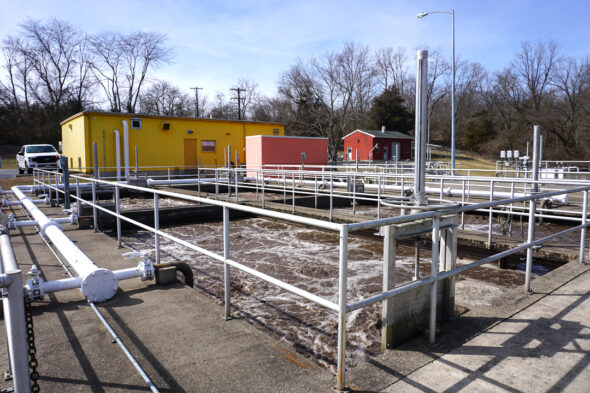
The Village's wastewater treatment plant on Grinnell Road, as it appeared in 2022. (News archive photo by Reilly Dixon)
$8.65 million in wastewater improvements recommended
- Published: August 31, 2026

Yellow Springs’ aging infrastructure and how best to repair some of it was again a focus of discussion at Village Council’s latest regular meeting, Monday, Aug. 17.
At the meeting, Council members heard a familiar story: Yellow Springs is laden with old underground pipes that need fixing, and planning for repairs today would be cheaper than making them under duress tomorrow.
That was the message of Ryan Brauen, project lead for the Indiana and Ohio-based firm Wessler Engineering, who on Monday delivered a presentation that emphasized the Village’s need to update several key pieces of wastewater infrastructure — namely some mechanics of the Bryan Lift Station at the foot of the U.S. 68 bridge near the Bryan Center, as well as the force main that carries most of the village’s wastewater to the treatment plant on Grinnell Road.


“I don’t want to present doom and gloom … but I know from a planning perspective, it’s wise to think of next steps,” Brauen said of the aging infrastructure.
In his presentation, Brauen noted that the Village prompted his firm to conduct the wastewater evaluation to identify “capacity and performance limitations” with regard to the anticipated increase in residential homes being built in Yellow Springs. A $59,000 grant through the Ohio EPA covered Wessler’s assessment.
Brauen said that, while the Village is able to accommodate the flow of wastewater generated from the current output of Yellow Springs residents and businesses, it’s approaching a threshold.
“The lift station has a capacity of 3.74 million gallons per day,” he said. “The average you generate is 3.15 million gallons per day. So it’s reaching the limits. You’re at about 90% of the capacity of that station.”
The top priority, though, is the force main — which is over 60 years old and is deteriorating without a contingency plan in the event of its total failure.
“It’s a critical piece of how you can all flush and how your businesses can operate,” Brauen said. “You need a plan to address it going forward.”
Following a months-long survey of the treatment plant and collection system conditions, Brauen presented the following recommendations, in order of priority:
• Replace the force main — all 2,900 feet of 16-inch ductile iron pipe underground. Such a replacement would cost $2 million;
• Replace a particular 30-year-old leaky pump at the Bryan Lift Station, which services 70% of all wastewater in Yellow Springs. Such a replacement would cost $1.2 million; and
• Rehab portions of the treatment plant — built in 1964 and upgraded in 2009 — to improve reliability and support long-term operations. Such repairs would cost $5.45 million.
The cost would total $8.65 million, should the Village make all three of these large-scale infrastructure improvements; it’s an amount that could be subsidized by state EPA dollars, but one that could mean an increase of an estimated $30 in monthly utility bills for residents, per the Wessler study.
“But these are costs that could be scaled or phrased according to finances and need,” Brauen said.
In other words, the Village could choose to do one, two, all or none of the recommended actions, with varying costs or consequences to the taxpayer.
Village Manager Johnnie Burns insisted on the importance of looking at the force main. At the meeting, he called on the voice of Todd Van Lehn, former owner of Van Lehn Construction Services, who has worked on the repair and replacement of area utilities since 1980. According to Burns, Van Lehn was the last person to put eyes on a part of the underground force main, around 20 years ago.
From that memory alone, Van Lehn said the main needs replacing imminently.
“There’s no contingency,” Van Lehn told Council. “It’s been a tragedy in the making. If it breaks, it would pollute the river [Yellow Springs Creek in Glen Helen] and would continue to do so for the three weeks it takes to replace — and that’s optimistic.”
What the Village chooses to repair or replace, to what extent and when, all remain to be seen — and, according to Brauen, those choices could hinge on the dollars available through the Ohio EPA’s Water Pollution Control Loan Fund.
Brauen said that, on behalf of the Village, at the beginning of next month Wessler will submit a preliminary engineering report to the state — one that highlights the state of the force main, lift station pump and needs of the treatment plant. Around February of next year, the state will announce which municipalities have access to funds to offset project costs.
“We’re not committing to spending all this money,” Council President Gavin DeVore Leonard said of the recommended $8.5 million in improvements. “We’re going to put together a working group to consider the options.”
He continued: “We’re doing a decent job of keeping up with the things that are coming day-to-day. This is part of capital improvement planning where there’s some big picture, long-term projects that haven’t been looked at closely that far ahead. This is part of the effort to do better with that.”
The Yellow Springs News encourages respectful discussion of this article.
You must login to post a comment.
Don't have a login? Register for a free YSNews.com account.





No comments yet for this article.