




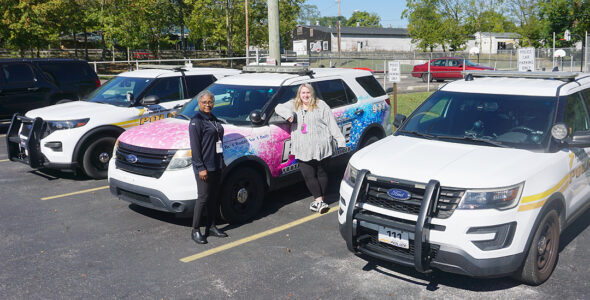
Village Community Outreach Specialists Florence Randolph and Danny Steck struck a pose by their “cotton candy-colored” cruiser earlier this fall. (Photo by Reilly Dixon)
Meet your community outreach specialists
- Published: December 16, 2025

When federal SNAP benefits stalled this fall, Yellow Springs’ safety nets snapped taut in an effort to catch as many affected folks as possible. Among those nets, and often helping bind them together, are the YS Police Department’s Community Outreach Specialists Florence Randolph and Danny Steck.
Responding locally to a nationwide crisis is part of the work for Randolph and Steck — but as they said in a recent interview, most days, their job involves responding to individual needs and the kinds of emergencies that don’t necessarily make the news.
Randolph, who has been in the job since April 2018, said the kinds of work she and Steck do overlaps with what a social worker might provide.


“We have a variety of needs that people bring to us,” she said. “People come to us with needs for food, utility payments, things like, ‘My car broke down, I broke my glasses’ — everything, anything. So we have a list of places we refer them to for resources.”
Contact information for all those and more resources can be found in the bevy of free pamphlets lining a wall in the lobby of the Bryan Center.
Police departments around the country have been inching toward similar models for years, collaborating with social workers or embedding social work positions within their departments, but news coverage and published research have illuminated an uptick in such efforts in recent years.
According to a 2022 study from the Brennan Center for Justice, incorporating social workers and other community outreach positions has become part of police reform, particularly in large cities, following the 2020 murder of George Floyd and public outcry over police violence. A 2023 study published in the Journal of Forensic Social Work notes that though there isn’t a unified model or approach to integrating social services into a police department, most involve creating pathways to resources to mental health, substance use and housing services.
In Yellow Springs, Randolph said, the department modeled its early program on a Boston precinct that employed a team of psychiatrists, nurses and social workers. Local resources don’t allow for the same approach within the YSPD itself, so the community outreach specialists collaborate with other organizations, including TCN Behavioral Health, the Mental Health Recovery Board, Miami Valley Community Action Partnership, United Way, the Senior Center, the YS Community Foundation, the schools, the John Bryan Youth Center, the YS Food Pantry, the Beloved Community Project and the “Who’s Hungry?” soup kitchen.
“We kind of are the go-between liaisons,” Randolph said.
Steck added: “We’re essentially working as connectors.”
A lifelong villager and 2017 YS High School graduate who joined the department this spring, Steck has several years of related nonprofit work behind her, having worked for Dayton’s National Conference for Community and Justice, or NCCJ, in suicide and bullying prevention in middle and high schools in Montgomery County. She said her work included leading the Mobile Opportunity Center initiative, in which she and others drove into neighborhoods in Dayton to provide support similar to what she and Randolph provide for the Yellow Springs community.
“We parked at the homeless shelter and worked one-on-one with clients to meet the needs they had,” Steck said.
When the Village of Yellow Springs opened up a second community outreach specialist position this year, Steck said she jumped at the chance to work in her own hometown.
“I thought, ‘How great would it be to do what I’m passionate about in my home?’” she said.
She pointed to her love and knowledge of the local community, as well as her own experience with need growing up, as fueling fires for the work she said she now feels privileged to do in the village.
“We struggled, but it didn’t always feel like we struggled — like, when the zoo trip came up every year and my mom couldn’t afford it, there was always somebody who paid to let me go on the trip,” she said. “The way that community comes together here, the ways that my family received help and the connections, that made me want to be part of that system that is helpful to people who live here.”
Randolph and Steck said there’s no such thing as an “average day” on the job, as they respond to needs wherever they might arise. The weekly exception is Tuesday, when they serve as victim advocates. On those days, they support victims and witnesses, act as liaisons with prosecutors and help lead folks through the court process and their rights. They also make referrals, keep victims updated on court dates, assist with impact statements and help secure protection orders when needed.
“We help that person navigate the court system and advocate on their behalf to the prosecutor and the judge in the court,” Steck said.
Every other day is a little of everything: phone calls, walk-ins, referrals from officers, sometimes assisting officers on calls. Steck explained: “If there’s a mental health crisis, or if there’s a death or something like that … Florence or I could, if the resident wants us to, respond to those calls and just provide emotional support and resources.”
The two often provide Tom’s Market food vouchers, Greene CATS bus tokens to get someone to Xenia or Fairborn or coordinate with the Wellness Center to provide shower access to those who need it. The most recent Village Manager’s report, presented at the Dec. 1 meeting of Village Council, noted that, from Nov. 13 to 24, Randolph and Steck provided five bus tokens, 43 food vouchers and three gas cards to folks, and provided assistance with housing to seven people, rental assistance to three people, utility assistance to 23 people and mental health assistance to 30 people.
Steck and Randolph’s work isn’t limited to those who live within the village — “We handle all the services for people who live, work and visit Yellow Springs,” Randolph said — and sometimes the work means helping someone rebuild trust with a family member or neighbor.
“You’ve got to get to know the person,” Randolph said. “You’ve got to ask a lot of questions.”
Many of the resources to which Steck and Randolph refer their clients — particularly in the arena of mental health — rely on state and federal funding. Earlier this year, the Department of Justice eliminated nearly $90 million in grants that would have supported mental health and substance-use programs and police health collaborations nationwide. In an op-ed for The Columbus Dispatch, Newtown Police Chief Thomas Synan Jr. urged federal officials to reinstate the funding, writing: “Police officers cannot do it alone. This is a model that works. … When communities have only law enforcement tools but lack essential services, people fall through the cracks.”
Randolph said funding losses, whether or not they’re directly tied to the DOJ cuts, have had local effects, particularly as funding for TCN Behavioral Health was “cut steeply” in recent months. In late July, TCN announced that funding cuts would mean the end of a number of Greene County crisis services, including its 24-hour crisis line and crisis intervention team outreach and follow-up.
“So now, the walk-in services that we used to be able to refer out to, we can’t,” she said.
But Steck said community support remains steadfast in the village, which she observes in the everyday generosity of folks who drop off coats, food, bikes — whatever someone needs.
“That’s something that not all communities have,” she said.
And Randolph said she continues to find joy in helping people meet goals, whatever their size.
“A goal might be just to be able to pay rent and utilities for one month without having to get any help — that’s a success,” she said. “It’s challenging, but it’s very rewarding.”
She added: “I’m built for this job, and my heart is in this.”
To reach the community outreach specialists, call the YS Police Department’s nonemergency line at 937-767-7206, or visit the YSPD at the John Bryan Community Center.
The Yellow Springs News encourages respectful discussion of this article.
You must login to post a comment.
Don't have a login? Register for a free YSNews.com account.





No comments yet for this article.