




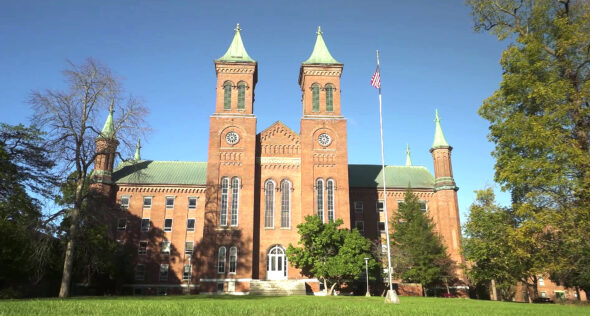
Main Building at Antioch College (Submitted photo)
Antioch students question college governance
- Published: July 3, 2026

Three days before Antioch College’s June 20 commencement, graduating student Lark Orbe and first-year student Zion Villines entered President Jane Fernandes’ office hoping to persuade her to reconsider a decision.
Suspended professor Michael Casselli had been told he could attend the upcoming July reunion, where he was set to receive the J.D. Dawson Award presented by alumni, but was barred from events where students he had taught and mentored would present their work and graduate.
Orbe had helped circulate a petition asking college administration to allow him to attend, gathering 181 signatures from students, alumni, current and former staff and other community members.


Orbe and Villines went into the June 17 meeting with another student — a small delegation that, as they told the News this week, they believed reflected Antioch’s tradition of community governance: students bringing a concern to institutional leadership and trying, together, to find a solution.
By that evening, the students believed they had reached a framework with Fernandes that limited Casselli’s presence to specific events, buildings and times. It would have allowed Casselli to attend the senior Colloquia, commencement, Grawlix creative showcases and the already-approved reunion events, while leaving the rest of his campus ban in place and acknowledging that the College would respond within the bounds of its policies if he exceeded the agreed-upon limits.
Orbe and Villines said Fernandes verbally agreed to the framework and told them written terms would be sent to Casselli the following day. Later that night, however, they said they learned that Fernandes had reversed course.
Casselli provided the News with an email, sent the following morning, in which Fernandes cited “fear and anxiety that has emerged on campus” and said Casselli would not be allowed to participate in any upcoming college events, including commencement and reunion.
Orbe and Villines said some students were disappointed that Casselli ultimately wouldn’t be present as they presented projects and crossed the stage at the Foundry Theater to graduate. But moreover, they said, they had counted on the shared governance that’s part of Antioch’s institutional character to illuminate a path forward for addressing a student concern.
“We don’t have to protest,” Orbe told the News. “We just need to sit at the table with [Fernandes] and talk to her.”
“It’s not my goal to see anybody lose at the end of the day,” Villines added. “If [Fernandes] were to get along with that, if we were able to get along with it, and also the community was aware of what was taking place, I felt like that would have been a win across the board for everybody.”
The News reached out to Fernandes this week with questions about the conversation she had with the student delegation; though she declined to respond to the students’ account point-by-point or comment on whether an agreement had been reached and reversed, or why, she provided a written statement:
“I respect and value students’ perspectives and contributions in all decisions that impact their education and overall experience at Antioch College. Student voices and inclusion are the foundation of Antioch College. As President I have to balance student input with the safety of campus and all community members.”
The statement continues: “We understand the community’s interest and concern, but we must reiterate that we will not publicly share specific details related to a personnel matter.”
As the News reported earlier this month, Casselli — a member of Antioch’s arts faculty since 2011 who earned tenure in 2021 — has been barred from campus since February after he was initially terminated that month following an argument with another faculty member. The Board of Trustees later suspended the termination and restored his pay and benefits pending review of the incident. On May 20, Fernandes placed Casselli on indefinite suspension without pay with conditions for a possible return.
In the weeks since his suspension, Casselli has acknowledged in the pages of the News and online that the argument became heated and said he apologized for his behavior, but has disputed the College’s characterization of the incident and argued that he was denied the process owed to a tenured faculty member. The American Association of University Professors has also raised concerns that the College subjected Casselli to what they called a “major sanction, second in severity only to dismissal,” without a hearing before an elected faculty committee.
Orbe, who graduated last weekend, said the visit with Fernandes grew out of student discussions and wasn’t initiated by Casselli. Villines said he joined the student delegation because he believed the campus restrictions were disproportionate and the dispute had escalated unnecessarily.
“We didn’t have to get here,” he said.
The student body wasn’t unanimously energized with regard to Casselli’s campus ban, Orbe said, as some students were overwhelmed by the final weeks of the term, and others didn’t take an active role. But Orbe said the proposal came out of student meetings and did reflect a broad student concern, particularly among those who had worked closely with Casselli. Those students, and others, protested Casselli’s initial firing in February, carrying signs that read: “Be ashamed to die until you rectify.”
Villines, who transferred to Antioch during the winter term, said he had expected Casselli to teach some of the courses in which he’d enrolled, but the professor “disappeared” from campus not long after Villines arrived. Though Villines is up to speed on the circumstances of Casselli’s suspension, he said the College hasn’t yet clearly explained to students how it intends to fill the educational gap left by his absence.
“I understood Casselli would be my professor for a lot of the classes that I would be involved in,” Villines said, adding that he had hoped Casselli would teach him about how to use CAD, a 2-D and 3-D modeling software. “Are you gonna hire somebody else to fill that gap? Are you consolidating the program into a different program? What is your strategy moving forward in this?”
Orbe said they first emailed Fernandes about the petition and asked to meet; when no meeting had been scheduled by the final week of classes, Orbe raised the request during a campus community meeting. Fernandes agreed to meet, and the students gathered the next morning.
A member of Antioch’s human resources staff expressed concern before the meeting that what was initially understood as a one-on-one meeting had expanded to include several students, writing that the College did not want “a group against one.” Orbe responded that the delegation’s attendance was not intended to overwhelm Fernandes, writing: “I invited other students because, though I have spearheaded the initiative of the petition, it is not just me, but a community effort.” They also told the News that they had asked Fernandes in advance if they could invite other students to the meeting, and Fernandes had responded affirmatively.
Orbe said they appreciated that Fernandes agreed to the meeting at all, particularly during a crowded final week that included commencement preparations and a Board of Trustees meeting. They said they entered the conversation believing that an in-person exchange — even if it ended in disagreement — could still build trust.
“It’s important that we meet face-to-face on something that’s really important to me and the community,” Orbe said.
Orbe and Villines said the June 17 meeting began with the students asking Fernandes to reconsider Casselli’s exclusion from the senior Colloquia and commencement. They said Fernandes agreed within a few minutes of discussion, and those gathered in the room moved swiftly on to discussing guardrails.
“[The meeting] wasn’t centered around whether he could or couldn’t be present,” Villines said. “It was how his presence was going to be governed.”
During the meeting, the students said they began drafting a document to outline the course of the discussion, titled “Official Terms of Institutional Permittance,” which identified the specific events and spaces where Casselli would be allowed. It was drafted by the students, though Villines and Orbe noted that it was not signed by Fernandes.
Orbe said that, in a second meeting with Fernandes later the same day to review a final draft of the “Official Terms” document, they asked whether anyone else on campus needed to be notified or consulted because of concerns about Casselli’s presence, and that Fernandes indicated she would handle those conversations. Orbe said they left expecting the terms to be finalized and sent to Casselli the following day.
Instead, Orbe received a text message from Fernandes that evening indicating that the decision had changed. The next morning, Casselli received an email from Fernandes that read: “Given the fear and anxiety that has emerged on campus, I will not allow you to participate in any of the upcoming events at Antioch College including Commencement, visiting [Olive Kettering Library], Reunion and others. As is currently the case, you are not allowed on campus and you are not allowed to teach students. Failure to comply may result in termination.”
Villines said that he and other students were confused by the apparent about-face in the decision, and that they weren’t given an answer on what constituted the “fear and anxiety” that had apparently caused it. He said he would have respected a clear refusal from the outset, particularly if the College had clearly explained that safety or personnel considerations made the request impossible.
“Sometimes we have to make hard decisions and give reasoning towards those hard decisions,” Villines said.
In a public statement released June 19, Villines wrote that the administration should have said “no” from the beginning if it was unwilling or unable to approve the students’ request. Students spent part of their final week working toward a solution they believed had been accepted, he argued, only for it to be reversed in “whiplash decision-making.”
Orbe said they felt similarly: “We would have been like, ‘Well, we’re disappointed that this is still the case, but we appreciate that she met with us and could say ‘no’ to our faces,” they said.
Addressing the commencement audience at the Foundry last weekend, Orbe spoke to the responsibilities that come with living in a community and participating in its governance: “Antioch is special because we have community governance. Students, staff, faculty, administrators and alumni serve on committees and make decisions collectively — which is unheard of at many other institutions.”
Orbe went on to urge students to commit to institutional work at Antioch, saying: “When you have an issue, don’t just chat with each other about it. Document it, send that email, go to Community Meeting, join a committee. Commit to the long term process. Be heard!”
Their advice resembles what Orbe and Villines said they attempted in Casselli’s case: discussing the issue among students, circulating a petition, asking for a meeting, negotiating terms and putting those terms in writing.
Orbe said that, in their view, shared governance doesn’t mean every student demand must be granted, nor does it remove the difficulty of making decisions when people have competing needs, access requirements or fears. They acknowledged in their speech that governance can be “messy and riddled with missed communication,” and told the News that students also bear responsibility for how they enter difficult conversations.
“We might be responding to something that we don’t have enough context around, but then help us understand,” Orbe said, adding that students can’t function as meaningful participants if decisions are made or reversed without a clear explanation of what changed.
“An agreement was made, and then that was broken. What happened in between, we don’t understand,” they said.
Orbe said they still hope to speak with Fernandes again directly; the president had proposed another in-person conversation during commencement weekend, Orbe said, but the timing didn’t allow enough space for the discussion they wanted to have.
“I hope to still meet with her; I hope to actually genuinely be curious about some of these things,” Orbe said. “As long as she’s in this position, we should be trying to work with her. I want her to see students and community members as people who want to work with her.”
Villines said that, as a new student, he came to Antioch expecting shared governance to mean difficult conversations among people with different perspectives, not the absence of conflict.
“I understood that there was probably going to be a lot of points of conflict,” he said. “But I also understood that there is a more beautiful way to move.”
The Yellow Springs News encourages respectful discussion of this article.
You must login to post a comment.
Don't have a login? Register for a free YSNews.com account.






No comments yet for this article.