





John Crawford III— An enduring grief
- Published: October 8, 2026

About a dozen people gathered at WYSO on Sept. 8 to remember John Crawford III. Local resident Bomani Moyenda had brought several pages of notes: a timeline of vigils, protests and other efforts to seek accountability after Crawford was shot and killed by Beavercreek police inside a Walmart in 2014.
Moyenda has helped organize memorials for Crawford year after year. At this year’s local event, held a month after a vigil in Beavercreek marking the 12th anniversary of Crawford’s death, Moyenda said he wanted to revisit what people in Yellow Springs and the surrounding area had done to keep Crawford’s name and story from fading from public consciousness, and to give Crawford’s father a chance to speak with those who still follow the case.
“We have refused to let this whole thing just die out,” Moyenda said.


Lest we forget: Crawford was 22 when Beavercreek police Officer Sean Williams shot him on Aug. 5, 2014. Crawford had picked up a pellet rifle from a store shelf and was talking on a cellphone when officers approached him. They were responding to a 911 call from another Walmart customer, Ronald Ritchie, who claimed Crawford was holding a gun and pointing it at others in the store. Surveillance video showed that Crawford was not pointing the pellet gun at anyone, and showed Williams firing within seconds of encountering Crawford in the pet food aisle. No one was criminally charged in connection with Crawford’s death.
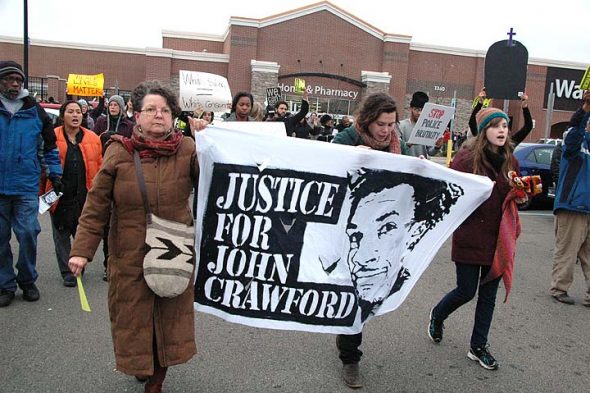
From left, Yellow Springs residents John and Maria Booth and Liz Porter were among the participants in Black Lives Matter protests at the Beavercreek Walmart in December 2014, following the police shooting death of John Crawford III in August. (News Archive photo by Diane Chiddister)
For those gathered at WYSO last month, the case was also a piece of local history they had lived through. Moyenda recalled hearing about the shooting that night and growing suspicious of the first accounts of what had happened. Once he saw the surveillance video, he said, he spent hours watching it and trying to understand how others could see the same footage and reach a different conclusion about whether Crawford had threatened anyone.
“I used to try to believe in the innate goodness of mankind, but that made it real challenging,” Moyenda said.
The weeks that followed Crawford’s killing brought vigils outside the Greene County Courthouse. Moyenda recalled that about 100 people came at first, then the numbers dwindled. The group kept going as the weather turned cold. One attendee remembered seeing the protesters outside the courthouse in the dead of winter.
“I was stunned that you all were out,” they said.
Moyenda also described a planned die-in — when protestors lie down on the ground in opposition to violence — at the Beavercreek Walmart during the holiday shopping season. He remembered arriving to find hundreds of people. The plan, he said, had been to gather inside the store, speak about Crawford and then move outside to protest along the street. Instead, the store closed for several hours and a number of protesters were arrested.
“I wasn’t expecting any of that really,” Moyenda said, adding that the turnout showed how strongly people had responded to Crawford’s death and the release of the surveillance video.
Since then, Moyenda said, memorials have taken place at the Walmart and in Yellow Springs. At WYSO, attendees recalled taking letters from concerned residents to a federal official and trying to keep attention on the case as the investigations continued. They mused on the fact that Crawford’s death was a regional locus of police violence against Black Americans, one story of many across the country that both preceded and followed; less than a month before Crawford’s death, Eric Garner was killed by a police officer in New York City. Four days after Crawford’s death, Michael Brown was shot by police in Ferguson, Missouri. In November that year, 12-year-old Tamir Rice was killed by police while playing in a Cleveland park; he, like Crawford, was holding a pellet gun.
One person present said Crawford’s death changed how she understood stories of violence she had previously watched on the news. Hearing about something so close to home, she said, “made things real for me.”
“It was in our backyard, so of course we felt a lot closer to it,” added Mayor Steve McQueen. He also recalled documenting protests and memorials as a Community Voices producer for WYSO. Years later, he said, students doing school projects about Black Lives Matter contacted him with questions about Crawford, with some writing from Virginia and California.
Local resident John Booth described seeing a white customer enter a Walmart recently with a handgun in an open-carry holster. No one appeared to be alarmed by the visible weapon, he said; he couldn’t help but think of Crawford.
“It’s just right there. It just tells you it’s a double standard,” Booth told the group.
Though there were no criminal consequences for anyone involved in Crawford’s death, his family sought accountability through civil litigation. In 2020, the city of Beavercreek agreed to pay Crawford’s estate and family $1.7 million to settle a wrongful death lawsuit. A separate claim against Walmart continued and was later dismissed, but in November 2022, a three-judge panel of the U.S. Sixth Circuit Court of Appeals revived the family’s wrongful death claim against Walmart. The appeals court ruled that a jury could consider whether Walmart’s failure to secure the pellet rifle, or to train employees to respond when a customer carried one through the store, contributed to Crawford’s death.
Moyenda supported the family’s effort to hold Walmart accountable. He hoped it would bring a substantial payment, but told the News in 2022 that money had a limit: “There can be no justice since John Crawford III is dead and can’t be brought back.”
The Walmart case ended without a trial. In August 2025, attorney Michael Wright announced that a confidential settlement had been reached “for the benefit of the Crawford children.” Though, at the time, the amount of the settlement was not disclosed, Crawford’s father, John Crawford Jr., has stated that the amount of the settlement was $750,000. WHIO reported last year that federal court records showed the family’s case had been “voluntarily dismissed with prejudice,” meaning the claim couldn’t be brought again. In the intervening months, John Crawford Jr. has disputed how the case was handled by the family’s attorneys and the courts.
After the attendees shared their memories at WYSO, the group moved indoors to hear from John Crawford Jr. by video. He had hoped to attend in person, he told the group, but a scheduling conflict involving his own father, for whom he is the primary caretaker, kept him away.
Moyenda said he first met Crawford Jr. in 2015, outside a federal building on a bitterly cold day when residents were seeking answers from federal officials.
“I could feel the anguish and the passion that he spoke with,” Moyenda recalled. He said that meeting persuaded him to put sustained effort into the case, and over the years, he and Crawford Jr. have remained in contact.
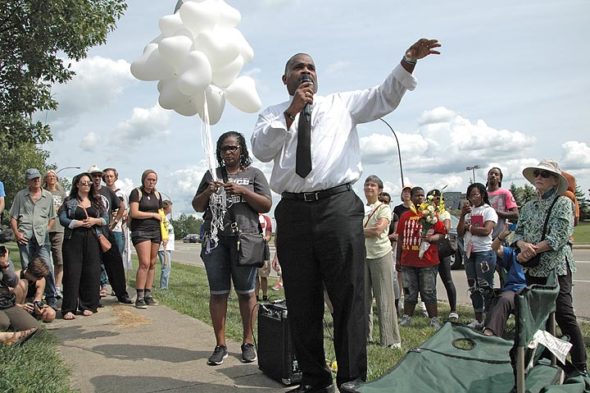
John Crawford III’s parents, John Crawford Jr. and Tressa Sherrod, pictured above, took part in the commemoration; Crawford Jr. delivered a powerful call for justice, and Sherrod released 25 balloons in honor of her son’s 25th birthday in August 2017. (News archive photo by Audrey Hackett)
Crawford Jr. told the group he opposed the Walmart settlement and is seeking to overturn it. He noted that Butler County Probate Court records show the court removed Crawford’s mother, Tressa Sherrod, as administrator of the estate in February 2025 and appointed an attorney to serve that role in her place; the court approved a settlement and its distribution that May. Crawford Jr. said he and Sherrod had rejected the proposed settlement because they considered it inadequate restitution for the killing of their son.
“I emphatically reject the settlement; it’s egregious,” he said, recalling what he told the probate judge.
This year, Crawford Jr. filed documents challenging the settlement. He described returning to case documents years after his son’s death and trying to understand decisions made when, he said, grief had left part of his mind elsewhere.
“At the time all of this was happening, part of me wasn’t even there,” he said. “I was somewhere else. … Rule of thumb with me is I read everything, I watch everything. But you know, when you’re going through the process in real time, it didn’t happen that way.”
Twelve years on, the September gathering was far smaller than the demonstrations Moyenda recalled from 2014, and the few years that followed. For Crawford’s father, the death of his son remains at the front of his mind, no matter how much time has passed.
“It’s been 12 years,” Crawford Jr. said. “To me, it’s been 12 minutes ago.”
The Yellow Springs News encourages respectful discussion of this article.
You must login to post a comment.
Don't have a login? Register for a free YSNews.com account.





No comments yet for this article.