




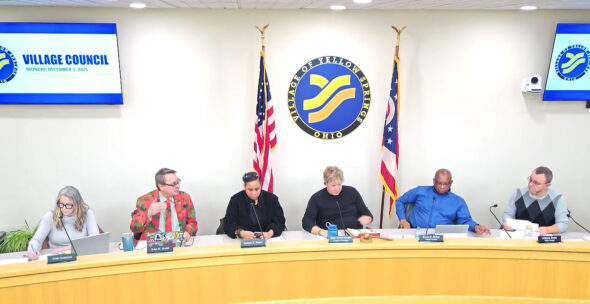
Present for the penultimate Council meeting of the year were Trish Gustafson, Brian Housh, Carmen Brown, Gavin DeVore Leonard, Kevin Stokes, and Village Manager Johnnie Burns. (Video still)
Village Council approves 2026 budget with $558K deficit, but ‘strong’ cash reserves
- Published: December 8, 2025

At the group’s most recent regular meeting, Monday, Dec. 1, Village Council approved the 2026 municipal budget — one with a projected deficit of $558,100, with municipal expenses expected to outpace revenues.
In a memo to Council ahead of their meeting, the Village’s finance director, Michelle Robinson, noted that while the Village’s general fund and several enterprise funds are anticipated to go into deficit spending over the coming year, the Village continues to maintain “strong” cash reserves. By Robinson’s projections, the Village may end the coming year with more than $4 million in the general fund.
“That said,” Robinson wrote, “the Village manager and the finance committee are firmly committed to narrowing the deficit through ongoing fiscal discipline and strategic planning. Together, we remain focused on achieving a balanced and sustainable budget by 2028.”
As Council member Brian Housh put it, this budget reflects a conservative financial strategy oft employed by the Village — to underestimate forthcoming revenues, and overestimate expenditures.
Of the $18.1 million in total appropriations of all the Village’s funds for 2026, the general fund — the primary fund for government operations, including money for Village Council, mediation services, commissions and administrative costs — has $5,411,913 for the coming year.
As in years past, the largest portion of the 2026 general fund is public safety; the new year’s total is $2,243,786.
Elsewhere in the budget are the capital project funds — which account for the financial resources used to construct, acquire or improve municipal assets — and the enterprise funds — which account for services and utilities that are financed primarily through user fees, rather than taxpayer support. Those funds, the capital and enterprise, budgeted $1,125,960 and $9,658,945 respectively.
The largest appropriations from the budget’s special revenue fund — totalling $1,947,488 — include $808,424 for parks and recreation, $781,583 for street maintenance and repairs and $374,138 for Bryan Center operations.
At the beginning of Monday’s meeting, appropriations for the Village’s affordable housing fund — another special revenue fund — started with $243,034, but by the end of the meeting, it grew to $311,247.
This increase was the result of a motion made by Council Vice President Gavin DeVore Leonard to set aside the additional money for local affordable housing nonprofit Home, Inc., to further help the organization cover the costs associated with the ongoing construction of The Cascades senior apartment project.
DeVore said that the added amount he sought to appropriate for Home, Inc. — $68,213 — would specifically help the nonprofit “close the gap” in funding phase two of the apartments’ construction, provided Home, Inc. receives the state funding it aims to apply for in the coming months.
“So, if they don’t get the funding, then the Village won’t provide this match,” DeVore Leonard explained. “If they get the state funding, then this would be the amount needed to close out the project — to help best leverage state dollars.”
He added: “And to be clear, this wouldn’t impact the deficit at all. This would be an allocation from a fund that already has the dollars in it because we populated it last year.”
DeVore Leonard’s motion for setting aside the additional money for Home, Inc. was atop what had earlier been included in the 2026 budget: $20,000 to help subsidize the organization’s home repair grant fund, as well as an initial $60,000 for phase two of the Cascades project.
Housh was amenable to fulfilling Home, Inc.’s request for additional money to “close” any forthcoming funding gap, and noted that the existing money in the affordable housing fund to which DeVore Leonard referred, was initially money earmarked for any future low-income housing tax credit, or LIHTC, project that the Village could potentially help subsidize.
“We know we’re not scoring well for LIHTC, and that’s part of what those dollars were there for,” Housh said. “I don’t think we’re going to get it together for Glass Farm for at least a year.”
Council members Trish Gustafson and Carmen Brown expressed some displeasure with the move — not so much Home, Inc.’s request, but the last-minute maneuvering of budget line items.
“I don’t want this to set a precedent,” Brown cautioned her colleagues.
DeVore Leonard’s motion to add $68,213 to the affordable housing fund for the benefit of Home, Inc. — bringing the fund to a total of $311,247 — passed with him, Housh and Council President Kevin Stokes voting affirmatively. Brown and Gustafson voted “no.”
Once that motion was adopted, the group voted on the amended budget; it passed 4–1, with Gustafson as the lone “nay.”
Later in the meeting, during the public comments section, villager Ralita Hildebrand admonished DeVore Leonard for making what she characterized as an “abomination” of a decision to allocate additional funds for Home, Inc., and suggested he and others at the dais who were privy to the request ahead of Monday’s meeting acted without “integrity and transparency.”
“I have no problem with [Home, Inc.],” Hildebrand said. “None whatsoever. Nor do I have a problem with the fact that the Village ethos supports affordable housing. What I do have a problem with is the lack of transparency — that you have a private conversation, there’s no documentation and it gets discussed like over a dinner table. We’re talking about over $60,000.”
“We did everything right here. This is all we can do,” DeVore Leonard contended, and alluded to the constraints of Ohio’s “Sunshine Laws,” which prohibit more than two Council members from decision-making outside of public meetings.
“This is the process,” he said.
Gustafson disagreed.
“No,” she said. “When you have a change to the budget, you need a formal process … a presentation.”
In other Council business, Dec. 1—
• Village Manager Johnnie Burns introduced to Council a proposal to add a GoBus stop in downtown Yellow Springs.
GoBus is an Ohio-based intercity bus service with nine routes, 32 university connections and 27 local transit connections. More than half of Ohio’s 88 counties have GoBus stops.
Should Council authorize Burns to enter into an agreement with the Ohio Department of Transportation — with a vote anticipated at the group’s next regular meeting Dec. 15 — Yellow Springs will gain its own stop on U.S. 68, next to the Train Station.
According to a memo Burns provided to Council members ahead of Monday’s meeting, ODOT is still finalizing the operating schedule, with pickup and drop-off times expected to be released in 2026.
Burns’ memo also notes that the creation of this GoBus stop would not cost the Village any money, and that all operational and service-related expenses would be covered by ODOT.
• Council approved a resolution that increases the wage scale for Village employees by 3%. Additionally, the resolution authorizes Burns to approve merit-based wage increases for eligible employees based on annual performance evaluations in amounts not to exceed 5% annually.
• Council approved a resolution to increase the Village manager’s salary by 6%, and the Village clerk’s salary by 3%.
As Council members considered those three salary increase resolutions, several at the dais called for future legislative action to formally create a policy on merit-based municipal wage bumps — a policy that, as Housh characterized, wouldn’t be “at the total discretion of the Village manager.”
The next Village Council meeting will be Monday, Dec. 15, at 6 p.m. in the John Bryan Community Center.
The Yellow Springs News encourages respectful discussion of this article.
You must login to post a comment.
Don't have a login? Register for a free YSNews.com account.








No comments yet for this article.