




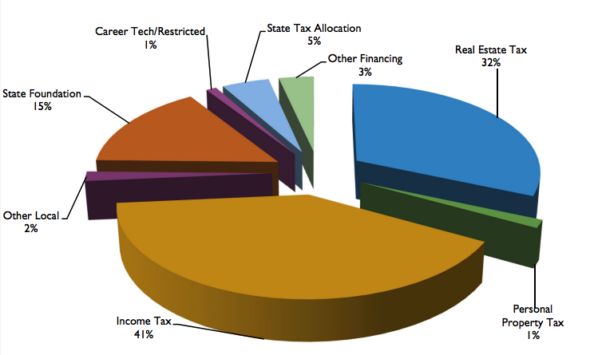
A snapshot of YS Schools' general and emergency fund for fiscal year 2025–2026. Total revenues are $7,817,574.20. (Graph courtesy of Yellow Springs Schools)
State property tax laws to affect district’s budget forecast
- Published: March 3, 2026

Yellow Springs Schools Treasurer Jacob McGrath told school board members at their Feb. 18 meeting that the district remains financially stable through the end of the decade.
At the same time, he said the district faces growing uncertainty as new state property tax laws begin to affect both local revenues and the district’s future levy options.
McGrath presented the district’s five-year financial forecast during the meeting; he noted that the district began deficit spending in fiscal year 2025, and explained that expenditures are projected to exceed revenues consistently moving forward, with the district drawing from its reserve cash balance for operations.


“The cash balance does remain positive through fiscal year 2030,” McGrath said.
This month’s five-year forecast marks the district’s first time incorporating the anticipated effects of four property tax bills signed into law in December — House Bills 129, 186, 309 and 335 — which take effect March 19. As the News previously reported, McGrath, Superintendent Terri Holden and current and former school board members raised concerns about the legislation last year, warning that it would limit revenue growth and narrow the funding tools available to school districts.
Of the four bills, McGrath identified HB 186, which affects the 20-mill floor, as being of particular concern to the district. The 20-mill floor is the minimum effective school property tax rate districts must collect, which previously allowed tax revenues to rise as property values increased. According to McGrath, property tax reappraisal in 2023 lowered the district’s millage rate to the 20-mill floor, allowing its revenues to grow.
Now, however, the new law retroactively caps property tax growth at the 20-mill floor based on inflation.
“So money that we have received, the state is changing property tax law and saying that we’re not going to get that,” McGrath said.
Because of the retroactive nature of the law, previously collected revenue will be “clawed back” in fiscal year 2027, and at the same time, the district will feel the effects of the first full year of reduced property tax growth, McGrath said.
“Fiscal year 2027 will see the full brunt of it,” he said.
Based on current estimates, McGrath said HB 186 could cost the district about $421,000 in fiscal year 2027, followed by roughly $280,000 annually through fiscal year 2030. The state has indicated it will provide temporary payments to offset some local property tax losses, but McGrath said the Ohio Department of Taxation hasn’t yet released any “authoritative figures” on how much they’ll provide to districts.
“Without the details on how these bills are going to be implemented, it’s difficult for us to anticipate exactly what our revenues are going to be,” he said. “We’re waiting for the Ohio Department of Taxation report to come in April.”
HB 129 also affects the forecast by changing how the 20-mill floor is calculated. Beginning with the next county reappraisal cycle, emergency and substitute levies will be included in that calculation, where previously they were excluded.
“For us, this is very impactful,” McGrath said.
The district estimates the change will reduce property tax revenue by about $313,000 beginning in tax year 2026, collected in 2027. McGrath said the shift could also affect revenue growth from new construction that districts would otherwise expect.
“Instead of seeing growth on the 20-mill floor like we would anticipate, we might see no growth whatsoever,” he said.
McGrath said the new laws also change what kinds of levies districts can place on the ballot. Previously, districts could put emergency levies before voters, asking for a fixed sum of funding that could later be renewed at voters’ discretion in the form of a substitute levy.
HB 129 effectively eliminates the traditional use of emergency and substitute levies for school districts unless they were passed prior to 2026. Now, school districts can only pass five-year, fixed-sum levies if they are in fiscal distress or affected by a disaster as declared by the president or governor.
“It’s good that we passed our substitute levy when we did,” McGrath said, referring to a levy passed in late 2024 that combined and continued two previous emergency levies originally set to expire this year. The levy collects annual revenue of $1,975,000 for a period of 10 years.
He also noted that districts that carry over a cash balance equal to 100% or more of their annual general fund expenditures will no longer be allowed to propose new operating levies. Yellow Springs Schools does not currently meet that threshold, but McGrath said the restriction adds another layer of complexity to long-term planning for school districts.
“We do have limitations on what we can do to have new operating money in the future,” he said.
Despite projected property tax losses, McGrath said district revenues are expected to remain relatively stable over the forecast period.
“If you look at our total revenues, we’re doing OK,” McGrath said. “We’re up about $500,000 more than anticipated on income taxes.”
At the same time, costs for the district are expected to continue rising. Salaries account for about 50% of expenditures, benefits nearly 19% and debt service for the district’s facilities are about 15%.
McGrath said the district is not planning to seek new operating levies in the immediate future, but the new property tax laws will require the district to keep an eye on and discuss its levy strategy and timing in advance.
The district will revisit the forecast later this year after receiving updated property tax data from the state.
“We should be able to have a much stronger forecast in August,” McGrath said.
To view McGrath’s Feb. 18 presentation in full, go to http://www.youtube.com/@yellowspringsschoolsboe; supporting documents for the presentation are available online at www.go.boarddocs.com/oh/yellowev/Board.nsf
One Response to “State property tax laws to affect district’s budget forecast”
The Yellow Springs News encourages respectful discussion of this article.
You must login to post a comment.
Don't have a login? Register for a free YSNews.com account.






41% of the District’s General and ‘Emergency’ fund come from income taxes? the District better hope that calls to “eat the rich” go unheeded.