




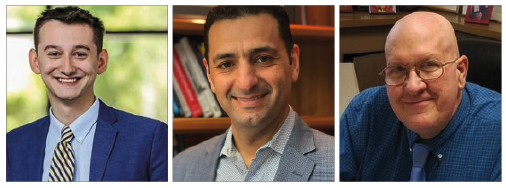
Sammy Caruso, Dr. Mustafa Musleh and John Wagner will be guest speakers at the upcoming forum discussion, “Advocacy for a Just and Sustainable Middle East Peace,” on Feb. 15 in the Herndon Gallery at Antioch College. (Submitted photos)
Community forum on Israel and Palestine held at Antioch
- Published: February 12, 2026

On a Sunday afternoon in mid-February, area organizers are hoping to pull area residents out of their familiar circles — not to agree, necessarily, but to listen, ask questions and leave with more information than they walked in with.
“Advocacy for a Just and Sustainable Middle East Peace,” a community forum focused on Israel and Palestine, will be held Feb. 15 from 4–6 p.m. at the Herndon Gallery at Antioch College. The event will feature short presentations from guest speakers followed by audience questions.
The forum will bring together three speakers whose work approaches the Israel–Palestine conflict from different vantage points: John Wagner, a retired pastor and a founder of United Methodists for Kairos Response, an organization aiming for nonviolent collaboration with Palestinian Christians to seek “freedom, justice and equality for all Palestinians and Israelis”; Sammy Caruso, a Dayton-area Jewish activist and creator of “Echoes of Gaza,” an online archive cataloging media coverage of Gaza; and Dr. Mustafa Musleh, president and co-founder of the Palestinian American Medical Association, which supports Palestinian healthcare workers and provides emergency and long-term medical aid in Gaza and the West Bank.


Judith Hempfling and Suzanne Fogarty, both members of the Greater Dayton Peace Coalition, have been working to organize the event; Hempfling said the idea that sparked the forum grew after Wagner, a retired United Methodist minister and fellow coalition member, returned from the West Bank late last year.
“It just occurred to me that … it would be good for people to be better informed about what’s happening there,” Hempfling said, adding that she herself was “very ill-informed” prior to the Oct. 7, 2023, Hamas attack on Israel, and the devastating ongoing humanitarian crisis in Gaza that has followed in its wake.
Speaking with the News this week, Wagner said he has traveled to the West Bank four times. His first trip in 2008, he said, upended his assumptions.
“I was very skeptical; I wasn’t anti-Palestinian or really pro-Israel,” Wagner said. “I just have a lot of Jewish friends, and was loath to criticize Israel, and I felt like I ought to be more even-handed. … I thought, ‘It can’t possibly be that bad.’ And it is. Really, the situation shocked me, just how systematic and brutal this occupation was [in 2008]. It’s gotten much worse.”
In September of 2024, Wagner said, amid Israeli bombing of Gaza, villagers in the area of the West Bank he visited were repeatedly attacked. When he visited again in November of 2025, a Palestinian Christian friend reported that the Israeli government was threatening to take over the farm his family had lived on for more than 100 years.
“His motto is, ‘We refuse to be enemies,’ and he’s being threatened,” Wagner said. “This is one of the ways I am seeing how systematic the takeover is.”
Wagner added that he often hears the conflict framed as endlessly complex, which he believes can shut down conversations that might lead to greater ethical clarity.
“There’s a standard way to steer the conversation into saying, ‘They’ve been fighting for thousands of years, and it’s so complicated you can’t possibly understand,’” he said. “Maybe it isn’t as complicated as everybody’s saying — it really is the big and powerful beating up on the weak.”
Nevertheless, Wagner said that focusing on contemporary events doesn’t deny centuries of historical antisemitism, and that he understands the fear many Jewish Israelis carry because of historical trauma.
“But honestly, it didn’t come from Palestinians,” he said.
Hempfling said she believes Wagner’s story — not only the picture he paints about the conditions in Gaza, but of his own shifting perspective — is important for folks to hear, and that she expects those who are already reading, marching and organizing to attend.
“But my hope is also to get beyond the activists who already are well-informed,” she said.
She added that she and other organizers also hope to welcome Jewish community members to the event, and avoid what she said many see as a fast-hardening binary: that public advocacy for Palestinian rights is inherently antisemitic.
That led the organizing group to reach out to Sammy Caruso, who spoke in November at a Dayton “Call It Genocide” rally about his viewpoint as a Jewish American advocating for Palestinians. In its way, Caruso’s advocacy journey began similarly to Wagner’s: having grown up in Oakwood in a Reform Jewish family, he and his father took a trip to Israel after Caruso’s Bar Mitzvah.
“We knew we wanted to go into the West Bank … to go see some of the sites from the Torah,” Caruso said. “And during my experience in the West Bank, seeing separate roads that Palestinians and Israelis would drive on, seeing a settlement where my tour guide couldn’t go, seeing the living conditions for many of these Palestinians in the West Bank really was galvanizing for me. It made me want to learn more when I got back.”
Later, Caruso became a student at University of Michigan–Dearborn; notably, Dearborn has one of the largest populations of Arab Americans in the country. His time in the city, he said, helped shape his understanding further.
“I was very grateful to have that experience, to be in a community … with a lot of Muslims and Arabs, and getting to learn more about their culture,” Caruso said. “Growing up, I was not necessarily around Palestinians, so getting to hear their stories first-hand made it more personal.”
His experiences, he said, spurred him to begin saving and cataloging news articles about the occupation in Palestine; every time he saw a report that would “make [his] jaw drop,” he said, he would save it, because he worried it might vanish as the news cycle turned. Over time, that catalog became “Echoes of Gaza,” a web archive he and a group of 13 others have maintained since Oct. 7, 2023.
“We continue to find and save news articles that we are trying to protect from erasure, and keep Palestinian stories alive and keep history alive,” Caruso said. “That’s our own way of resistance.”
Since returning to the Dayton area, Caruso said he’s received criticism about his public advocacy around expressing solidarity with Palestinians.
“The big thing I’ve been getting pushback on has been calling it a genocide,” Caruso said, adding that he’s been meeting with Jewish leaders in the area to navigate how to “have that conversation within [the Jewish] community.” He said he’s also faced criticism and had difficult conversations about how antisemitism manifests, and his concerns that antisemitism can sometimes be conflated with Palestinian solidarity.
“I’m as concerned about antisemitism as anyone else in our community, but I think the ways we identify it and our concerns about it are sometimes how we differ,” Caruso said.
Wagner said he’s faced similar criticisms within his circles of ministry and advocacy — “It’s a very potent accusation for everybody, and the last thing most of us want to be, considering the history of our world, is an anti-Semite,” he said — but he hopes that conversations around what’s happening in Palestine can move beyond polemics and into understanding. And he noted that being preemptively labeled a “Zionist,” too, can sometimes shut down conversations that could lead to discernment.
“I’ve heard that on some college campuses, Jewish kids who are just starting school are asked if they’re sided with Palestinians, and if they don’t say ‘yes’ immediately, they’re considered fully committed Zionist stooges,” Wagner said. “I have all the sympathy in the world for a young person who comes to school and starts learning other things, and I’m always hoping they’re befriended by somebody who really knows what they’re talking about and understands where they’re coming from.”
Similarly, Hempfling said she’s been thinking about the people who might come to the upcoming forum event not because they’re certain, but because they aren’t — those who “may not feel like they have very complete information, and are not sure what to think.”
“You can’t just be mad at people if they don’t have the information,” she said.
To that end, Caruso said, he hopes the forum event will spark a dialogue in what he believes is the truest sense: folks coming to the conversation with “the intention of understanding and not the intention of changing someone’s mind.”
“Because if we can walk away understanding each other better, that is a win,” he said. “Being comfortable being uncomfortable and having uncomfortable conversations is healthy.”
Beyond that, Caruso said he hopes attendees will leave with two takeaways.
“I want them to hear a Jewish perspective — it’s not the Jewish perspective, but it’s a Jewish perspective — and that you can be proudly Jewish and still highly critical of what Israel’s been doing,” he said. “And Palestinians are not just what we read on the news. They are humans; they’re musicians, they’re engineers, they’re artists. They’re not just casualty numbers.”
“Advocacy for a Just and Sustainable Middle East Peace” will take place Sunday, Feb. 15, 4–6 p.m., at the Herndon Gallery at Antioch College and is being sponsored by the Coretta Scott King Center at Antioch College, the YS Friends Meeting, the Great Dayton Peace Coalition, the Dayton International Peace Museum and the Peace Resource Center at Wilmington College.
Admission is free; those planning to attend are asked to register at http://www.bit.ly/JustSustainablePeace26.
One Response to “Community forum on Israel and Palestine held at Antioch”
The Yellow Springs News encourages respectful discussion of this article.
You must login to post a comment.
Don't have a login? Register for a free YSNews.com account.







The headline had me skeptically hoping for balanced dialogue; a chance for the village to live up to its professed ideals of tolerance, empathy, and open-mindedness. The body of the article extinguished any hope of that. How could I have been so naive…