






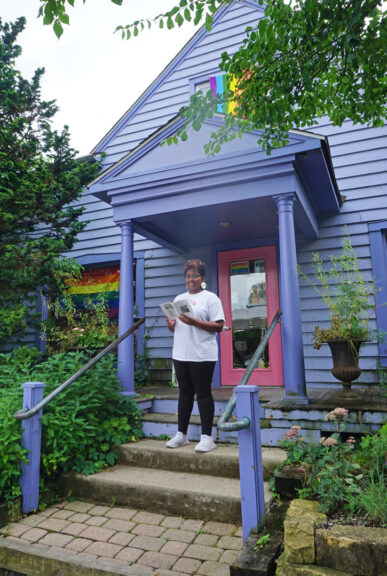
The 365 Project led a walking tour on Juneteenth 2026 that began at the Olive Kettering Library at Antioch. (Photo by Reilly Dixon)
Meet Your Nonprofits | Learning local Black history with The 365 Project
- Published: August 14, 2026

MEET YOUR NONPROFITS | This is the second in a series profiling the ongoing work of Yellow Springs-based nonprofit organizations.
By Alissa Paolella
When The 365 Project’s Black History Walking Tour reaches King’s Yard, Lila Crockett does not need her notecards. The storefront where Wildflower Boutique Yellow Springs stands today was once Rita Caz, a shop with a staircase full of guitars, a drum set in the corner and cases of handmade jewelry. It belonged to her grandfather, Mark Crockett. She was small when it closed. She is 17 now, and on select summer afternoons she stands on that block and tells visitors about a Black-owned business in Yellow Springs that happened to be her own family’s.


“It was a very fun store,” she said.
That short distance — between the history on the card and the teenager delivering it — is the whole idea behind The 365 Project’s walking tours, now in their 11th year.
The Yellow Springs nonprofit, founded in 2008 to preserve and celebrate the village’s African American history “365 days a year,” hands its tours almost entirely to young people, some recruited as early as sixth grade. They learn the streets, the names and the stories, and then they lead grown adults through them.
The tours are among the most public of the nonprofit organization’s efforts, which range from a community encyclopedia to oral-history recordings, Wheeling Gaunt Day and a hand in the village’s MLK Day, Juneteenth and Kwanzaa observances. The group also sponsors the Citizens’ Action Reparations Fund, now in its fifth year, moving money from villagers who want to give to Black residents who can use it.

Mayor Steve McQueen teaching Mills Lawn Elementary students about Wheeling Gaunt. (Photo by Reilly Dixon)
Taken together, the work of The 365 Project seems to repeat, for those who would hear, a question the village keeps asking itself as housing costs climb and its Black population thins: Who gets to stay in Yellow Springs?
In 1970, about 27% of Yellow Springs was Black, the result of a mid-century village that offered African American families affordable homes and comparatively open hiring. The 2020 census, by contrast, counted about 9% of the local population as Black, with nearly as many again identifying as more than one race. Kevin McGruder, The 365 Project’s treasurer and a history professor at Antioch College, said he sees the difference in the schools he helps bring tours to: classrooms of 20 or 25, often with only a few students of color.
The tour program was built, then, to involve those students in telling the story of local Black history, and make sure that story keeps being told. The program was modeled, in part, on that of a Cincinnati museum McGruder visited with then-board secretary, and current YS mayor, Steve McQueen and the late museum director Dr. John Fleming, where the three men encountered high school students who were paid to learn exhibits and work as docents. They thought the model was locally scalable — and Yellow Springs had no museum, so they made the village the exhibit.

Photo by Reilly Dixon
John Gudgel, a founding member and the organization’s president, whose family has been in Yellow Springs since the 1890s, recruits walking tour guides from inside the schools, where he has spent more than four decades. There are no auditions and no cuts, and the young guides are paid.
“We take anybody who has an interest,” he said, and the organization pairs newer guides with seasoned ones until they are ready to face a crowd. Two guides lead most tours.
Crockett was about 12 when Gudgel offered her the job, and said the draw for her, at first, was that the pay — $10 an hour to walk around and talk. She had severe stage fright until she was 12 or 13; the tours dissolved it. Now, she said, she’s the kind of student who picks the presentation over the essay, and has watched herself become the older guide, the one training children in her younger brother’s grade.
“I try to be really approachable and friendly, so that they know I’m not judging [them] for being younger,” Crockett said, adding that she remembers being the small one, nervous around anyone more than a few years older. “I think it’s a nice little statement about Yellow Springs, that they let the younger kids be in charge.”
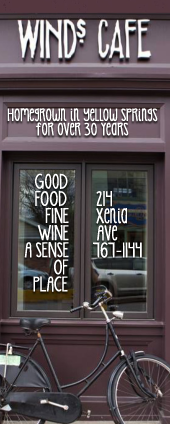
In 2022, Gini Meekin led a group in a “Black Food Traditions” tour — part of a tour series hosted by The 365 Project — which focused on Black-owned businesses. Above, Meekin stood in front of the Winds Wine Cellar, a building that formerly housed two Black-owned restaruants, Cassano’s Pizza King and Gabby’s Barbecue. (Photo by Jessica Thomas)
What a guide learns on a corner, McGruder said, is not in any classroom: the geography of their own town, and the fact that you can walk down a street with no idea who lived in a house or what happened there. The tours make the case that the community’s character was built and maintained across generations — and, though the guides may not say it outright, keeping that character will take the same deliberate effort.
“If they want this to continue,” McGruder said, “they’ve got to do it intentionally.”
Preserving the record is the reason The 365 Project exists. Its centerpiece is a community encyclopedia, “Blacks in Yellow Springs,” assembled beginning in 2017 by a committee of elders — many then in their late 70s and 80s — and published in 2020, with supplements still being added.
McGruder said the documents historians rely on tend to be the ones saved by wealthy families; the lives of everyday people slip away unless someone writes them down. Much of this history, he said, lives only in memory, and he is now the only one conducting the oral-history interviews that capture it. Some people on his list died before he reached them.
This year, the walking tour project brought every Mills Lawn Elementary class through the story of Wheeling Gaunt, the formerly enslaved man who bought his freedom, grew wealthy in Yellow Springs and left the village a legacy still honored each winter — delivering flour and sugar to local widows and widowers. Gudgel said he now hears the youngest students volunteer that the park by the pool is named for Gaunt.
“We know it’s resonating,” Gudgel said.
If the tours are how the village remembers, the reparations fund is how some villagers try to make amends. Its lead donor is Susan Harrison, a retired elementary school teacher who is white and who, by her own insistence, controls none of how the money is spent. She started the fund after the summer of 2020, when she marched in 25 straight weeks of racial-justice rallies in the village and kept turning over one phrase.
“The battle cry was ‘do something,’” Harrison said. “So, what can I personally do?”
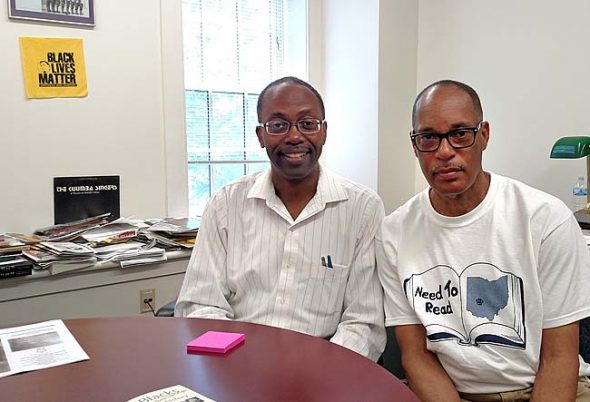
Antioch Professor of History Kevin McGruder, left, and lifelong Yellow Springs educator John Gudgel helped develop the “Blacks in Yellow Springs Encyclopedia,” highlighting the rich history of African Americans in the village. (Photo by Dylan Taylor-Lehman)
She took the idea to Gudgel and McGruder, who embraced it, and she was clear about why she did not wait for a larger authority before writing the first check in August 2020.
“If you wait for the government to do it, it can take forever and a day, and it’ll never happen,” she said.
She insisted from the start that she hold no say over recipients. A committee of Black residents makes those decisions, and applicants are asked for no proof of lineage or hardship.
“It’s in their hands. It is not in my hands, and it never was going to be,” she said. “I didn’t feel I had any right to do that.”
Harrison has given about $110,000 of her own money over five years, she said, and intends to keep giving “into perpetuity.” She moved out of Yellow Springs to nearby Xenia in 2021 and funds the village’s reparations effort from outside it.

In 2024, young guides Demarion Howard and Lila Crockett led participants on a Black history walking tour in Glen Forest Cemetery, stopping at the monument of Wheeling Gaunt. (News archive photo by Reilly Dixon)
McGruder, who frames the fund in the language of the wealth gap, puts the same point in historian’s terms. In the aggregate, he said, the net wealth of Black families in the United States runs to roughly a tenth of that of white families, a gap rooted in generations of enslavement, exclusion from postwar housing wealth and discriminatory lending. The fund, he said, asks white residents who benefited from that history to help Black neighbors who did not.
The money has bought and repaired used cars, retired medical debt, seeded small businesses and, McGruder said, helped residents get current on rent and utilities.
Giving tends to move in waves, rising when a letter to the editor or a newspaper insert reminds people it is there; Harrison recalled an early insert that brought in about $17,000 and, more recently, an appeal to past donors that raised roughly $11,000.
Whether any of this keeps Black families in Yellow Springs is a harder question, and no one at The 365 Project claims a clean answer. McGruder is careful to say retention is not the fund’s stated purpose, though grants toward rent and utilities have, in practice, helped people hold on. He is equally careful about the tours, which have shifted over the years from mostly Black guides to an increasingly white group as the village has changed — a development he views, glass half full, as one that sends young allies back to their friends with a history they might not otherwise hear.
Lila Crockett said she traces her own future path — toward art history and, she hopes, a museum somewhere — directly to the tours. She may carry this history somewhere else.
What young guides take with them, Gudgel said, is “a sense of community and giving back and empathy,” whether they remain in Yellow Springs or not. Crockett, he added, “typifies what I’m hearing from guides as they get older.”
The real test for the organization, though, is in its own succession: Gudgel and McGruder have carried much of its work for close to two decades, and both wondered where the project will be in another 10 or 15 years without new people who feel the same urgency.
Their answer, for now, is the children — the seventh-graders Crockett is coaching, the kindergartners who already know Gaunt’s name.
This season’s last tour, Saturday, Sept. 12, is“Wheeling Gaunt’s Yellow Springs,” and it coincides with the annual Wheeling Gaunt Day. The tours are free, and they begin, most days, at Mills Park Hotel, where a group of adults gathers on the sidewalk and waits for a teenager to tell them where they are.
The Sept. 12 walking tour will begin at the Wheeling Gaunt statute at the Yellow Springs Train Station, 101 Dayton St. For more information about The 365 Project, visit the365projectys.org.
The Yellow Springs News encourages respectful discussion of this article.
You must login to post a comment.
Don't have a login? Register for a free YSNews.com account.




No comments yet for this article.