





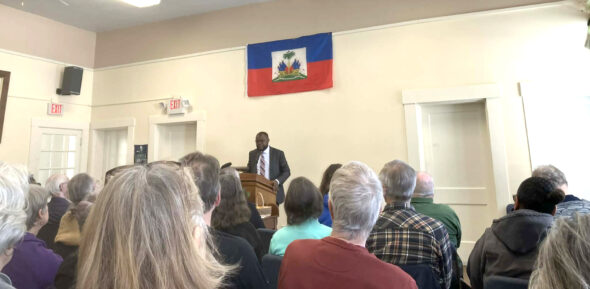
Over the last several weeks, a great many Yellow Springs residents have been up to what they historically do best: checking in with their neighbors and resisting injustice all the while. (Photo by Reilly Dixon)
Yellow Springs rallies behind Haitian neighbors
- Published: February 5, 2026

Supply drives and fundraisers, peace vigils and sermons. Hanging posters, staging demonstrations, protesting, networking, organizing — a lot of organizing — and planning for worst-case scenarios.
Over the last several weeks, a great many Yellow Springs residents have been up to what they historically do best: checking in with their neighbors and resisting injustice all the while.
Specifically, some villagers and local activists have been working to ameliorate the fate of the estimated 15,000 Haitian residents in Springfield, whose immigration status has been in flux, who’ve been the target of racist falsehoods at the national level and who potentially face deportation back to their politically unstable and often violent Caribbean homeland.


These efforts have come to a crescendo recently, particularly as the country’s more than 330,000 Haitian immigrants were expected to lose their temporary protected status, or TPS, on Tuesday, Feb. 3.
Losing TPS would force many, if not all, Haitian immigrants without permanent residency to return to their home country. At the same time, the expiration of TPS could bring federal agents — particularly Immigration and Customs Enforcement, or ICE, agents — to Springfield and other communities like it, subjecting them to the kind of unrest and violence that claimed two lives in Minneapolis last month.
Ahead of the anticipated expiration of TPS on Feb. 3, Springfield, Yellow Springs and the surrounding area rallied.
The day before, hundreds packed St. John Missionary Baptist Church on the south side of Springfield to show solidarity and spiritual communion with the city’s Haitian residents — who amount to about a quarter of the city’s population. The gathering was well attended; reports indicate the fire marshal said the church was over its 700-person capacity, and more than 150 people were asked to leave.
Activists from Yellow Springs, Springfield and beyond; faith leaders from throughout the state; members of the Yellow Springs-based World House Choir; national reporters and media stations; and Haitian community members filled the church to hold vigil, sing and pray together ahead of the anticipated immigration crackdown in Springfield.
Whether that comes, remains to be seen.
Hours after Monday’s gathering at St. John ended, a federal judge blocked the Feb. 3 expiration of TPS.
U.S. District Judge Ana Reyes in Washington granted a request to pause the Department of Homeland Security’s termination of TPS. In her 83-page opinion, Judge Reyes granted a stay maintaining the legal status of Haitian nationals, and accused DHS Secretary Kristi Noem of “preordaining” her termination decision because of “hostility to nonwhite immigrants.”
“During the stay, the Termination shall be null, void, and of no legal effect,” Reyes wrote.
But already, the Trump administration said it will appeal, thereby leaving Yellow Springs’ Haitian neighbors — and the hundreds of thousands of other Haitian immigrants across the country — right where they were at the beginning of the week: vulnerable and awash in uncertainty.
Springfield resident, local pastor and Haitian Support Center co-founder and executive director Viles Dorsainvil said in a public statement that he was thankful for Reyes’ decision — that it will “lower the pressure quite a bit and ease the fear that has been in the community,” and that his prayers had been answered.
Dorsainvil — whose voice was last in the News in December, ahead of the HSC’s two-year anniversary and the Jan. 1 Haitian Independence Day — said as much at Monday’s packed St. John, ahead of Judge Reyes’ ruling, and the day before, as guest speaker during the local Unitarian Universalist Fellowship’s Sunday service.
“What we are praying for is a redesignation of TPS, not an extension,” Dorsainvil told the UUF congregants, two miles south of Yellow Springs. “But either one, there will be a fight back and forth between us and the government. We must act now. We do not have faith in this administration to wait.”
Presiding over the morning’s service was villager Al Schlueter, who noted before Dorsainvil took the podium that the meeting house was more crowded than usual, with about 70 attendees — mostly villagers — present to hear their Haitian neighbor speak.
Schlueter began by reminding attendees of Leviticus 19:34: “The foreigner residing among you must be treated as your native-born. Love them as yourself, for you were foreigners in Egypt.”
During his hour-long message, Dorsainvil spoke to the ongoing systemic and colonial forces that expelled him and other Haitian nationals from their home country — the social and political instability of their home has culminated in such omnipresent and sanctioned violence that 1.4 million people were displaced from Haiti in 2025 alone.
“There is a tremendous contradiction in speaking about Haiti as the first independent Black country in the world, and one of the richest colonies of the French empire,” Dorsainvil told the congregants. “And now — now, Haiti is the poorest country in the western hemisphere. How does Haiti get to this point? We must consider the destructive policies of the international community — the U.S., France and Canada — and the ways oligarchs have governed and exploited the country.”
Two centuries of exploitation, intentional underdevelopment from colonial powers and the resulting poverty that turns children into violent gang members, that separates fathers from daughters, that leads to assassinations and human rights abuses — it’s these factors that forced Dorsainvil and 15,000 others to Springfield, he said.
And it’s those factors, he said, that make him fearful of being deported back to Haiti, should TPS expire and ICE knocks.
“People ask us, why are we here?” Dorsainvil said. “I ask them the same question. Why am I here? Why should I be here?”
He later added: “We would be happy to go home — and I would be the first person to leave — but we cannot,” noting that he and other U.S. immigrants could be abducted, tortured and killed by gangs upon their return to Haiti.
With or without Monday’s federal ruling — cause for some local optimism — Dorsainvil encouraged the congregants at UUF to continue pitching in to aid Yellow Springs’ Haitian neighbors, especially with so many uncertainties ahead.
• The Society of St. Vincent de Paul of the Springfield Region provides assistance with independent living — food, rent, utility, medical, advocacy and more — for immigrants and the needy in the Springfield region.
Monetary donations to that organization can be made at http://www.bit.ly/4tgnvqh
• Springfield’s Advocates for Basic Legal Equality, Inc., or ABLE, is a nonprofit regional law firm. According to its website, it’s been instrumental in helping thousands of people maintain their immigration status and eventually become U.S. citizens. ABLE provides free legal services to people living in poverty in Ohio, and has assisted hundreds of Haitian individuals and families fleeing violence in their home country.
Monetary donations to that organization can be made at http://www.bit.ly/4qrlTaU
The Yellow Springs News encourages respectful discussion of this article.
You must login to post a comment.
Don't have a login? Register for a free YSNews.com account.






No comments yet for this article.