






The center 25 acres of Glass Farm, a portion of which are pictured above, are being considered for affordable housing. In the background are the section of the land under a conservation easement, and farther back, are homes in the Thistle Creek neighborhood. (Photo by Reilly Dixon)
Village Council renews affordable housing efforts for Glass Farm
- Published: July 6, 2026

Village Council and administrative staff covered considerable ground at a recent housing retreat, Thursday, June 25, from discussions on potential zoning code changes and population growth, to municipal-owned housing and villagewide rental surveys.
But what emerged from the four-hour meeting as Council’s most sizable and immediate effort at realizing its top goal — creating more affordable housing opportunities in Yellow Springs — was the unanimous commitment to building new homes on Glass Farm.
“We’re basically saying right now that our staff and Council energy is going toward thinking about how to do development on Glass Farm,” Council President Gavin DeVore Leonard said last Thursday.
“That doesn’t mean we’re never going to be interested in developing other [Village-owned] properties or what to do about them, but we have a limited amount of resources and so now, our focus is on Glass Farm, and there is no expectation that things are moving on other projects,” DeVore Leonard said. “Is that a fair summary?”
“I would say yes,” Village Manager Johnnie Burns replied.
Owned by the Village since 1974 and located in the northwest reaches of Yellow Springs, the 42-acre Glass Farm has been the locus of conservation and housing-related discussions and debates for several decades.
On the land’s western-most six acres is a 2.5-megawatt solar farm that went online in 2017; the eight acres on the property’s eastern border are under a conservation easement, rendering the pond and prairie there shielded from development. To the south and southwest of the land is the new Spring Meadows subdivision, with its infrastructure pointing northward for any future connectivity.
According to Village documents, the center 25 acres of Glass Farm are what’s being eyed for housing.

Present for the Thursday, June 25 housing-focused retreat in Council Chambers were, clockwise from top left, Village Manager Johnnie Burns, Council President Gavin DeVore Leonard, Council Vice President Angie Hsu, Planning and Zoning Administrator Nía Holt, Assistant Village Manager Elyse Giardullo, and Council Members Carmen Brown, Senay Semere and Stephanie Pearce. (Video still)
In a memo to Council ahead of the retreat, new Village Planning and Zoning Administrator Nía Holt wrote those efforts would be pursuant to the recommendations outlined in the 2020 Comprehensive Land Use Plan, which stated that “portions” of those 25 acres “could be developed for a range of housing types.”
A conceptual rendering in the land use plan shows that the land — zoned R-B, or moderate-density residential — could accommodate a variety of homes, from single-family to multifamily units. Access points to such a development could connect to Yellow Springs-Fairfield Road to the north, King Street to the east and the Spring Meadows subdivision to the south and southwest.
“I don’t think people are talking about putting high rises on every square inch of the land,” DeVore Leonard clarified. “But we have this land … and it can help us reach some of our goals in a way that makes sense.”
As Holt reminded Council members in her memo, the land use plan — which received feedback from around 150 community members the months before its publishing — is a template that can be tweaked based on Council desires, forthcoming feasibility analyses and, above all, community input.
“Staff and Council are committed to a community-driven process grounded in the Comprehensive Land Use Plan,” Holt wrote. “Staff will work with Council to develop a community engagement plan and incorporate prior CLUP recommendations, such as a request for proposals, or RFP.”
She continued: “Prior to the release of the RFP, staff and Council will work together to establish sufficient community consensus on the desired housing types for Glass Farm to inform solicitation. Once that direction is established, the RFP process will move forward. Following RFP issuance, interested developers will be encouraged to engage with key stakeholders including the YS Development Corporation and Spring Meadows Homeowners Association. The selected developer will be required to conduct formal community engagement activities with residents, organizations and other stakeholders during the development process.”
Burns said that he will include a more concrete timeline for the issuance of an RFP by Council’s July 20 meeting.
Council members appeared amenable to that plan, and several insisted on the seriousness of bringing local voices into the decision-making process.
“Community engagement is critical,” Council Vice President Angie Hsu said. “We know the community cares, is concerned, is invested. Such a big part of this is engaging them in a process that is productive, informative and forward thinking.”
DeVore Leonard proposed the possibility of staging a charrette or a town hall in the coming weeks to hear ideas and concerns from local residents. Hsu and Council member Carmen Brown agreed to spearhead those forums.
“I would like to do it soon, really really soon,” Brown insisted.
For Brown, any housing initiative on Glass Farm must incorporate green building techniques.
“That’s where the buck stops with me — it has to be a conservation development with homes built in the most energy efficient way possible, doing the least amount of harm to this property,” she said.
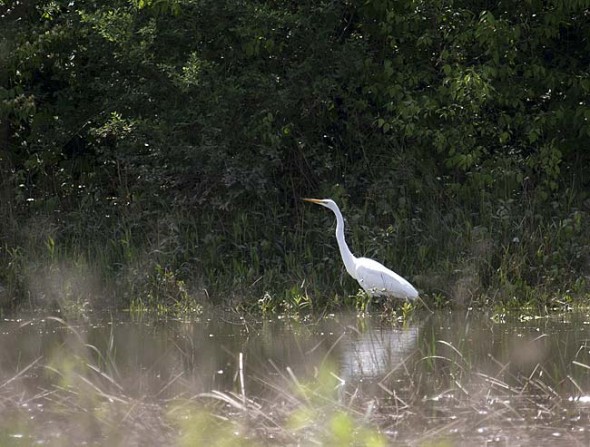
A great egret pauses to display its elegant white plummage in the wetland at Glass Farm. The egret is one of numerous birds and other species of wildlife that have been spotted in the area. In 2015, Village Council gave a green light on submitting a Clean Ohio grant application to preserve the area and make it accessible for low-impact recreation. (Submitted Photo by Scott Stolsenberg)
A brief history of Glass Farm housing
Village leaders have tread cautiously around the topic of Glass Farm over the last 25 years.
At the turn of the millennium, it was at the center of a fraught, townwide debate that turned neighbors against one another, and at the core of the controversy, put environmental concerns at odds with the need for more affordable housing in Yellow Springs.
Per past News reporting, in 2000 Village Council considered a proposal to partner with the then-nascent local affordable housing nonprofit YS Home, Inc. on a development on Glass Farm. While all Council members supported building more affordable homes, they disagreed vehemently on how to do it.
Under the proposal, the Village would transfer part of the farm to Home, Inc. at no cost. The nonprofit would then build 20 to 30 moderately priced homes over nine years and sell them to families of median or less than median income. The plan would keep the homes affordable by requiring that the homeowners resell the house to another moderate-income occupant.
Displeased with some Council members’ handling of that plan and other Village initiatives, a large group of villagers tried to remove two members from office by in a special recall election. Those efforts failed, but past News reports note the lasting political fissure in town that resulted from the recall attempt.
By 2001, opposition to housing on Glass Farm grew, and the plan became increasingly controversial. A local group known as Save Another Farm — a nod to the 1999 campaign to save the Whitehall Farm from development — organized and urged Council to put the development plan to a vote.
Council refused, but the activist group still pursued a referendum by circulating a petition calling for a vote on the land transfer. Within 10 days, the group had 617 signatures, almost twice as many needed to force a vote. Council invalidated that petition on the advice of the Village solicitor; lawsuits followed.
By October, Council relented and agreed to put the proposal up for special election in Feb. 2002. The affordable housing plan failed to pass — voters turned down the issue by a margin of 20%, with 942 voters rejecting the plan and 629 in favor.
In the years since, efforts to develop Glass Farm have come and gone.
The two decennial Comprehensive Land Use Plans published following the referendum have suggested that residential development of the land would be consistent with the existing subdivisions in the area — Park Meadows, Kingsfield, Stancliff and Thistle Creek, and now, Spring Meadows, which is anticipated to grow by an additional 190 units in the coming years.
But while development has been on Glass Farm’s door, some villagers continue to vie for its ecological significance and preservation in its entirety, beyond just eight protected acres.
Such a discussion sounded out most recently in Council Chambers in 2021 when then-Council member Laura Curliss petitioned her colleagues to fund a wetland delineation study on the whole of Glass Farm — one that, she suggested, would indicate that the “hydric soils” of the property are not suitable for development.
“Farm is a misnomer,” Curliss wrote to the Village Environmental Commission in 2024. “The land called ‘Glass Farm’ is a historic wetland. In 2021, no fewer than three wetland scientists provided this information to the Environmental Commission.”
With respect to the latest efforts to develop Glass Farm, some villagers continue to emphasize the land’s importance.
“Glass Farm is a wetlands with a high water table, reportedly ranging from 3–18 feet,” Pamela Nelson wrote to Council before its retreat last week. “Even with significant topographical alteration, the soil remains saturated, which can result in long-term issues such as unstable foundations, water intrusion, mold and increased prevalence of mosquitoes and ticks that carry disease.”
For now, it appears that Village Council’s ambitions for Glass Farm will be guided by the last Housing Needs Assessment of Yellow Springs, published by Bowen National Research in 2018.
As previously reported, the study drew from local market conditions and demographic trends in the village to recommend growing the local housing stock significantly — namely more affordable and workforce housing.
For instance, at least in terms of affordable housing, the study recommended adding:
• One hundred rental units for those with very low income, with monthly rents less than $500. In the eight years since the study’s publication, Yellow Springs has added zero such units;
• Eighty rental units for those with low income, with monthly rents between $500 and $875; Yellow Springs has added 20 such units.
• Forty entry-level homes that cost less than $150,000; Yellow Springs has added six such homes.
“This is what we want to focus on,” Council member Hsu told her colleagues at the retreat. “This is where we are putting our time and energy.”
Echoing her, DeVore Leonard said : “Our efforts are going to go toward getting more affordable housing. That’s the direction.”
The next Village Council meeting will be Monday, July 6, at 6 p.m., in the John Bryan Community Center.
The Yellow Springs News encourages respectful discussion of this article.
You must login to post a comment.
Don't have a login? Register for a free YSNews.com account.





No comments yet for this article.