



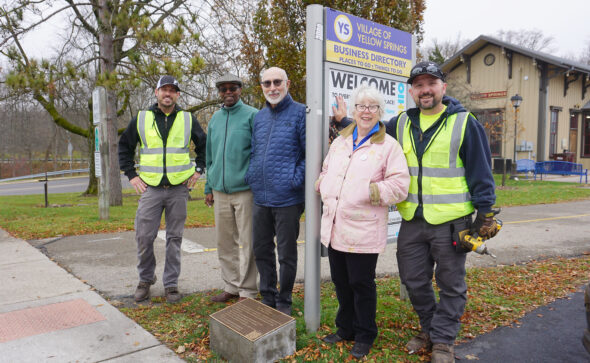
From left: Tanner Bussey, Kevin McGruder, Len Kramer, Antonia Dosik and Preston Harris were all smiles after unveiling a plaque that marks the end of a new self-guided Black history walking tour around the village. The tour is the product of collaborative work between The 365 Project, Livable/Equitable/Age-Friendly Yellow Springs, the YS Community Foundation and the Village of Yellow Springs. (Photo by Lauren "Chuck" Shows)
Take yourself on a tour, learn about Black history in Yellow Springs
- Published: December 6, 2025

On a cold and blustery morning last month, Village employees Tanner Bussey and Preston Harris took the wood forms from around a rectangle of freshly set concrete.
Villagers Kevin McGruder, Len Kramer and Antonia Dosik applauded as Bussey and Harris’ work revealed a plaque detailing the history of Dayton Street as the primary district for Black-owned businesses in the 20th century.
The reveal of the plaque signaled the launch of a new self-guided Black history tour around Yellow Springs, which aims to make local history more accessible year-round, expanding the reach of an effort that began nearly a decade ago with The 365 Project’s guided walking tours.


The self-guided tour, a collaboration among The 365 Project, Livable/Equitable/Age-Friendly Yellow Springs, or LEAFYS, the Yellow Springs Community Foundation and the Village of Yellow Springs, is working to pair permanent markers with an online map and historical notes designed for residents and visitors to follow on their own.
The self-guided initiative complements The 365 Project’s mission to promote “diverse African-American heritage, Black culture and racial equity, 365 days a year.”
Since 2016, that work has included the youth-led “Blacks in YS” walking tours designed around a variety of topics, including Black businesses, Black women leaders, Black landownership, the Black history of local schools and Antioch College, among others, woven through more than 200 years of local Black history.
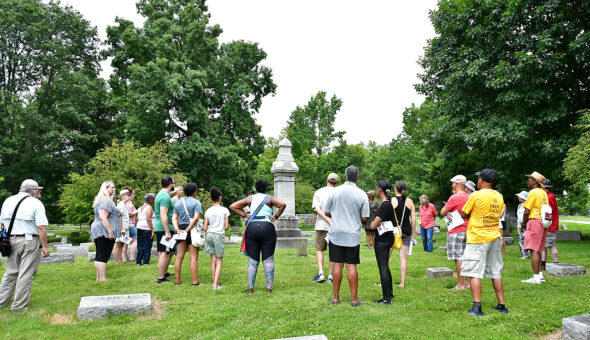
In 2021, the Blacks in Yellow Springs held a cemetery tour that told the stories of the Black villagers who are buried there. (Photo by Kathleen Galarza)
History professor and longtime 365 Project member McGruder, who helps research the tours and train middle and high school student guides, said the new, self-guided format fills a longstanding gap.
“We just finished our 10th year of walking tours,” he said. “I think the idea was, how do we have a presence for people who don’t get a chance to go on the tours?”
That need dovetailed with feedback collected through LEAFYS, a communitywide assessment of how welcoming and accessible the village feels to residents across all age, race, income and ability demographics. LEAFYS assesses the village across eight domains: outdoor spaces and buildings, transportation, housing, social participation, respect and social inclusion, employment and civic participation, communication and information, and community support and health services.
According to Dosik, project director for YSLEAF, the self-guided tour responds most directly to the “respect and social inclusion” domain, which emphasizes communitywide recognition of contributions, good information and activities that bring people together by being accessible. The group gathered data via a communitywide survey, and Dosik said the data showed that “many people don’t feel connected to what goes on in the village.”
“We developed a whole bunch of programming to help people feel more included, and this was part of it,” she said, and emphasized LEAFYS’ commitment to equity: “Part of what we wanted to do was programs that had an equitable quality, and we thought this project would help people feel included and really reflect [Yellow Springs’] history and commitment to equity.”
McGruder said that, with so many local sites connected to local Black history, it was a challenge to narrow the self-guided tour’s focus — “When we were trying to figure out what was reasonable for walking, we couldn’t have 30 different locations,” he said — but ultimately the group’s planning committee selected 10 sites.
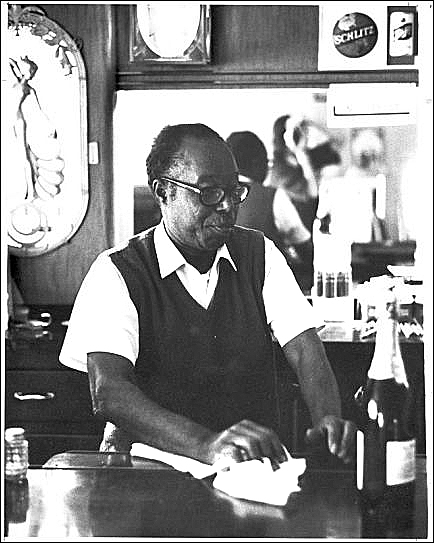
Hillard “Com” Williams at his W. Davis Street restaurant,
Com’s, in the early ’70s. Williams ran the popular
restaurant with his wife, Goldie, for nearly 30 years. (Photo courtesy of Antiochiana, Antioch College)
Liz Robertson, a 365 Project member and graphic designer, helped put together a website that includes a map of the suggested route through all the stops on the tour, as well as historical context and photos for each site. The stops on the tour represent a cross-section of civic, commercial and religious history in the village, with the route beginning at the intersection of Xenia Avenue and Corry Street, noting former and current Black-owned businesses, including the first Black-owned Cassano’s Pizza franchise, Gabby’s Pit BBQ and YS Toy Company, among others; the inception of the Elaine Comegys Film Festival at Little Art Theatre; the protests held when barbers at Gegner Barbershop refused to cut the hair of Black men; and the location of a historical marker honoring author Virginia Hamilton.
The tour continues down Xenia Avenue to the building that formerly hosted First Baptist Church, originally the Anti-Slavery Church; then to the former Davis Street location of Com’s Restaurant; to Central Chapel AME Church on South High; the Stafford Street home of Gabby Mason of Gabby’s Pit BBQ; an Elm Street schoolhouse that taught Black students before schools were integrated in the late 19th century, and then onto the Dayton Street Union Schoolhouse; philanthropist Wheeling Gaunt’s Walnut Street home; the Dayton Street business district; and a final stop at the bronze statue of Wheeling Gaunt near YS Station.
Thus far, the self-guided tour’s physical presence is anchored in two plaques already installed, marking the beginning of the tour at Xenia and Corry and its end on the bike path. Each plaque includes historical text and a QR code linking directly to the self-guided tour map. Grant funding from the YS Community Foundation supported the website, design work and initial materials.
Len Kramer, who helped connect the LEAFYS effort with The 365 Project, said the groups aim to place plaques at all the stops on the tour, but that the group is still raising money for that purpose. In the meantime, even without plaques at every location, the map and website allow visitors to follow the full route and read about each stop.
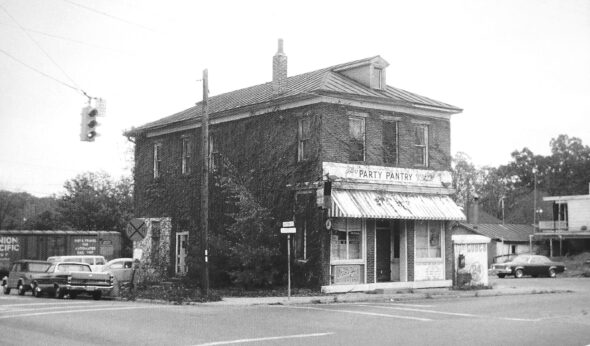
The Party Pantry, located where Trail Town Brewery now stands. (Photo courtesy of Antiochiana, Antioch College)
“Understanding the rich history of African Americans in this community, we want to make sure that’s preserved,” Kramer said.
“This is right out here for anybody to see anytime they’re here,” Dosik said. “It kind of elevates it, broadens it and sends it out into the world.”
McGruder noted that the work remains ongoing — not only the tour itself, but the broader project of documenting a history that, for a long time, wasn’t documented as it is now, in The 365 Project’s “Blacks in YS” encyclopedia and in the content of the walking tours.
“We’re all learning,” he said of the community’s awareness of local Black history. “A lot of our history is not in documents, it’s in people’s memories, and that’s always growing.”
He pointed to The 365 Project’s Black History Month effort this year to lead all Mills Lawn students on walking tours, focused on the legacy of Wheeling Gaunt.
“Those students will grow up with an understanding of who that was and why Gaunt Park is named for him,” he said. “So there’s all kinds of opportunities to continue learning.”
The self-guided walking tour map and historical guide are available online at the365projectys.org/blacks-in-ys-tour. For those interested in supporting the project’s expansion, donations can be made through The 365 Project’s website.
The Yellow Springs News encourages respectful discussion of this article.
You must login to post a comment.
Don't have a login? Register for a free YSNews.com account.




No comments yet for this article.