




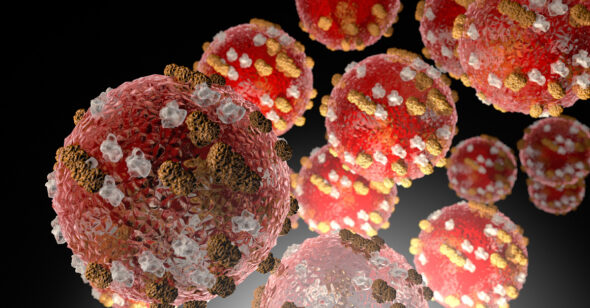
Rendering courtesy of the Centers for Disease Control and Prevention.
Ohio’s first measles outbreak of the year reported
- Published: January 27, 2026

On Jan. 9, Ohio Department of Health Director Bruce Vanderhoff reported the state’s first measles cases and outbreak of 2026.
There are three infected individuals, all children, from one household in Cuyahoga County. One of the three cases that is part of this outbreak had an illness onset date at the end of 2025, and the other two cases had onsets in 2026, according to the ODH.
The children were all unvaccinated at the time they were exposed and traveled to an area in the U.S. with an ongoing measles outbreak, the state health department reported. ODH is working with the Cuyahoga County Board of Health to follow up on potential exposures and to promote opportunities for vaccination.


“The fact that we again have measles cases in Ohio underlines the importance of being fully vaccinated,” Dr. Vanderhoff said in a release. “This disease can be very serious, but it is also preventable. I strongly encourage you to protect yourselves and your children by getting vaccinated.”
Measles is extremely contagious and can spread to others through coughing and sneezing. The measles vaccine — called MMR vaccine, as it protects against measles, mumps, and rubella — is very safe and effective at preventing measles. Two doses of MMR is 97% effective against measles.
If you are up to date on the measles vaccine, the risk of getting sick is very low.
The measles virus can live for up to two hours in air where an infected person coughed or sneezed. If other people breathe the contaminated air or touch an infected surface and then touch their eyes, noses or mouths, they can become infected. People infected with measles can
spread it to others from four days before, through four days after, a rash appears.
Measles symptoms include a rash, high fever, runny nose, cough, loss of appetite and red, watery eyes. The rash usually lasts five to six days and begins at the hairline, moves to the face and upper neck, and proceeds down the body. Diarrhea and ear infections are common complications of measles. More severe complications may also occur.
Complications from measles are more common among children younger than 5 years of age, adults older than 20 years of age, pregnant women, and people with compromised immune systems. As many as one out of every 20 children with measles gets pneumonia, the most common cause of death from measles in young children.
The Centers for Disease Control and Prevention recommends all children get two doses of the MMR vaccine, starting with the first dose at 12 through 15 months of age, and the second dose at 4 through 6 years of age. The MMR vaccine can also be given to adults who are not vaccinated or whose vaccination status is unknown.
Measles can be brought back to Ohio by individuals who travel internationally and within the United States to areas with ongoing measles outbreaks. If people are not protected against the disease, 9 out of 10 who are exposed will become ill.
Ohio had 45 cases of measles in 2025, including the first case mentioned above, and seven cases in 2024. The state had one measles case in 2023 and 90 cases in 2022, when an outbreak in central Ohio totaled 85 cases.
More information about measles is available on the CDC website — including general information and the recommended immunization schedule — at http://www.cdc.gov.
The Yellow Springs News encourages respectful discussion of this article.
You must login to post a comment.
Don't have a login? Register for a free YSNews.com account.





No comments yet for this article.