





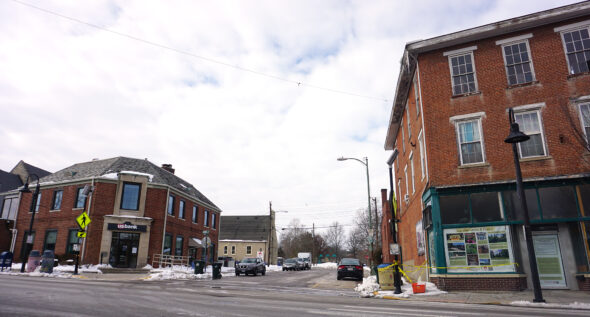
After being cleared of snow, benches, tables, portable toilets, some art installations and and even cornhole boards, Short Street became another regular road on Monday, Feb. 9. (Photo by Reilly Dixon)
Short Street reopened to traffic, for now
- Published: February 9, 2026

After nearly seven months as a pedestrian-only space, Short Street reopened to vehicular traffic on Monday, Feb. 9. Now, it’ll function as another regular downtown street — at least for now.
The decision came after a lengthy and fraught discussion at the most recent Village Council meeting, Monday, Feb. 2, and it marks the conclusion of a pilot project that the Village launched last summer to establish a public space in downtown Yellow Springs.
Since Street Fair last June, Short Street has been the site of several widely attended community celebrations and gatherings. The Village outfitted it with several benches, tables, decorative lights and some public art and flora. Hacky sack players gather there regularly. All told, four parking spaces were lost in the experiment.
Critics of the community space have argued that it’s underutilized in inclement weather, too expensive — costing $18,807 for all the items and amenities on the road — and generally disruptive for the flow of downtown traffic and parking.
This village debate came to a head Monday following a presentation by Assistant Village Manager Elyse Giardullo, who spoke on the Village’s challenges and successes in turning a road into a pedestrian-friendly hub.
Her presentation outlined and explored three possibilities: turning Short Street into a year-round gathering space, a six-month gathering space or returning it to a roadway. Villager and architect Max Crome provided renderings for both kinds of gathering spaces. Crome’s designs included a water feature, ornate planters, a covered structure and an open area that could accommodate a dance floor or retractable skating rink.
Though Village staff, YS Schools, the Chamber of Commerce and YS Police recommended that Council authorize the Village to pursue a year-round community space — which would cost an estimated $780,000 and take around three years to build — Council voted 4–1 on a motion made by Council member Stephanie Pearce to reopen Short Street to drivers. Carmen Brown was the dissenting voter.
A permanent public space on Short Street — the likes of which Giardullo advocated for in her presentation and which Crome conceptualized — is not entirely off the table.
A majority of Council members said they were amenable to pursuing future gathering space options and designs on Short Street provided certain conditions are met: namely that funding sources are more immediately available and a clear vision of the final result is known and agreed upon from the outset.
To meet the first condition, Council encouraged Village staffers to continue exploring available grant funding that the Village could use to implement permanent closure designs.
However, Manager Burns insisted that funding sources for permanent public spaces — such as county, regional and state institutions, including the Ohio Department of Transportation and Miami Valley Regional Planning Commission — would be reluctant to give the Village money if Short Street isn’t closed in perpetuity.
“We can’t go forward with a ‘maybe,’” Burns said, noting that the Village was turned down for grant funding to build permanent bathrooms on Short Street this summer, as it was still considered a pilot project.
“The catch-22 we’re in,” Clerk Judy Kintner further explained, “is that staff cannot go after funding until Council makes a decision.”
Some Council members were unconvinced by this logic.
“I am very open to the concept of keeping Short Street closed,” Council member Senay Semere said. “What I am not open to is keeping it closed indefinitely without a proven funding plan.”
He added: “Something has to give. Right now, we’re feeling the effects of a town square without any of the benefits of a town square. … I just can’t stomach the idea of a planning period for another year.”
Council President Gavin DeVore Leonard thought along similar lines of financial trepidation, and wondered aloud about how creating a community space aligns with municipal priorities.
“This is really hard,” he said. “So much about this project is awesome and exciting, but I can’t help but think how I’d love to spend this much energy in addressing affordability and some other issues we’ve talked about.”
Vice President Angie Hsu echoed that sentiment. “This question of priorities is a huge one,” she said. “This takes staff time, looking for grants, applying for them. Well, what types of grants? What do we want staff applying for as it relates to other topics like affordability, housing and economic development?”
Council member Brown said she was attracted by Crome’s renderings — particularly those that depicted an “interim Short Street,” or one that could continue as a six-month gathering space with additional art, and one that would buy the Village enough time and social investment as grant funding for a permanent space is sought.
“There has to be room for an interim, for an in-between time to find funding sources,” Brown told her colleagues at the dais. “If this had been done a different way, then ideally the funding sources would have already been identified, there would have been a plan sooner and we would have had renderings from a world-class architect from the outset.”
Though there was some disagreement about the Short Street space itself, all five Council members said they were impressed by the downtown parking solutions Giardullo raised in her presentation — which, as Burns later noted, were pulled from the most recent Comprehensive Land Use Plan.
A possible plan the Village could pursue — irrespective of Monday’s and future decisions on Short Street — to improve downtown parking could entail striping up to 71 diagonal spots along Elm and Phillips, eight along Corry Street at Beatty-Hughes Park and 39 farther along Corry Street with access to the bike path.
Closer to Short Street, the plan recommends 35 diagonal spaces in front of Mills Lawn Elementary along Walnut Street, and four handicapped spaces in the Walnut Street-facing parking lot at First Presbyterian Church.
“So,” Hsu said, “that’s two action items we’re walking away with tonight: [improving] the safety of pickup and drop-off in front of Mills Lawn. That needs to be addressed on its own. And two, we need more handicapped parking downtown. I am supportive of the four spots at the church.”
Manager Burns said he was happy to follow the Comprehensive Land Use Plan’s parking recommendations, but urged Council members to keep inflation in mind when considering those and other public infrastructure improvements — including creating a permanent gathering space. In about eight years, Burns said, the cost of creating all that additional downtown parking rose from approximately $150,000 to $395,000.
“That’s what happens when we keep pushing decisions that staff bring,” he told Council members. “So, I don’t know how we can come back three or four years from now and start this whole process over again.”
Though Monday’s vote was the end of Burns’ pilot project — at least for now — Hsu suggested that the project yielded useful dividends for the Village.
“The resources spent on this project were smart and calculated,” she said. “That infrastructure and equipment can be used again. This did exactly what a pilot should do: visualize it, learn from it and move forward. I think we’re even more excited by what we’ve seen tonight.”
Semere added: “We now have some set of data, results, plans and renderings to go after grants with. I believe that’s a boatload of information to go after funding with.”
The next Village Council meeting will be Tuesday, Feb. 17, in the John Bryan Community Center. The regular session, at 6 p.m., will be preceded by a Council work session at 5 p.m.
The Yellow Springs News encourages respectful discussion of this article.
You must login to post a comment.
Don't have a login? Register for a free YSNews.com account.





No comments yet for this article.