





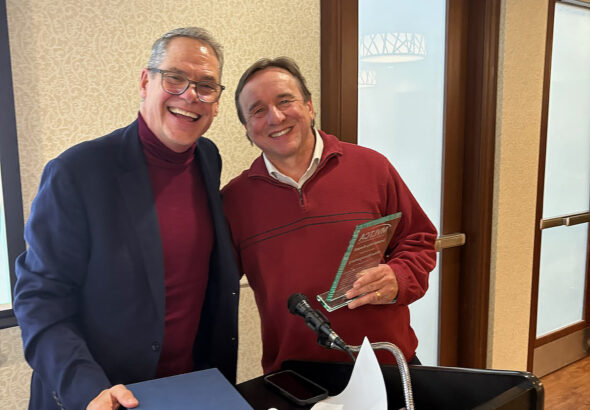
After more than eight years leading Friends Care Community, Mike Montgomery is stepping down from his role as executive director on Jan. 9. He’s pictured here late last year receiving a leadership award from the Miami Valley Long-Term Care Association. (Submitted photo)
Executive Director Montgomery to retire from Friends Care Community
- Published: January 18, 2026

Mike Montgomery didn’t plan to be the kind of executive director who stays behind a desk.
“I’m involved in everything,” he said. “I don’t have that corporate structure of a lot of my peers.”
This week, after more than eight years leading the nonprofit Friends Care Community, Montgomery is stepping out from behind the desk one last time, officially retiring from the position Friday, Jan. 9. In speaking with the News last month, he said he had expected to stay in the position “maybe a couple more years,” but that illness within his family has pulled the timeline forward.


“The board has enabled me to retire earlier than I had planned,” he said.
Montgomery’s departure from Friends Care comes during a time when long-term care is getting more expensive to operate, harder to staff and, he said, more dominated by corporations that can centralize services and spread costs.
“Especially on the for-profit side [of long-term care], many of them own not just four or five buildings in Dayton, but maybe 45 buildings in eight or nine states,” he said. “That’s one reason I wanted to be here; I prefer the independence that we have here.”
In his time at the helm of Friends Care, Montgomery said he’s learned that independence can protect something hard to measure: a facility’s ability to respond to the people who live and work there, rather than directives from far away.
“In other places, you might have somebody who comes up with something simple, like menu plans, and they’re out in New York; that might be great food for New York, but, you know, we’re meat and potatoes people here,” he said. “Dictates from outside the community just don’t work.”
As it happens, during his first years as executive director at Friends Care — a position he came into in 2017 after 13 years at the nonprofit, faith-based Grace Brethren Village, in Dayton — food service for residents was one of a number of issues Montgomery tackled to help boost morale for both residents and staff members. In addition to bringing food service back in-house to improve meal quality, Montgomery also worked to stabilize staff levels and hired more permanent staff, as well as overseeing feasibility studies for future expansion and spearheading renovation of the facility’s front entrance to make it more welcoming to visitors.
He also promoted longtime Friends Care employee Hannah Moorman early in his tenure, and for much of his time at Friends Care, she has been one of his closest operational partners. Moorman has been at Friends Care for 13 years, beginning as a licensed practical nurse before moving to management positions. After she received her registered nurse licensure, Moorman said, Montgomery hired her as director of nursing within a few months of his becoming executive director.
“He did not know me from Adam,” Moorman said. “He just said, ‘I see something in you, and I think you could do great things, and you’ve got the heart for long-term care.’”
Moorman said that her position and Montgomery’s have been complementary, and as such, she’s learned a lot from his people-first style of administration — an approach she said she shares — and that both jobs require “a lot of patience.”
“And he has taught me that you don’t have to know everything, and it’s OK to ask questions,” she said. “When there were times I felt like I failed, he told me it’s part of the process and lessons will be learned every day. He allowed me to be able to grow and learn. Keeping residents at the center, which is what I have always done — he’s done that as well.”
Working to maintain a staff who keep residents at the center of their approach has been a consistent during his tenure, Montgomery said, even as wage increases haven’t been matched by comparable increases in Medicaid and Medicare reimbursements from the state and federal governments. Though Friends Care has kept on board a number of long-term employees, like Moorman, the rising difficulty of retaining a full staff has been “the biggest change” during his time at the helm.
“In the past, I would always do wage studies against other facilities; now I have to do them against Walmart, against McDonald’s, because everybody’s competing for the same employees,” he said. “Ever since COVID, staffing has been hard.”
Montgomery cited the pandemic as the defining challenge of his career with Friends Care. Though he said protecting the organization’s resident-centered mission while keeping it financially stable in an industry that increasingly rewards scale and revenue has always been part of the job, the pandemic years brought that work into sharp relief, while also presenting a host of other hurdles. He credited Friends Care’s board, which by design draws representation both from Quakers and the broader village population, with helping the facility eventually clear that hurdle.
“We had no COVID cases [during lockdown] for our residents, but some of our staff members had COVID,” he said. “[The board] said, ‘We don’t have to fill a bed if we don’t have the staff’ — if we had been on the for-profit side, they would have wanted the revenue in here from a filled bed.”
Moorman said Friends Care’s goal during COVID was to keep residents safe, and that both she and Montgomery stood firm behind that goal.
“It made us one of the last 64 facilities in the country to get COVID,” she said. “We didn’t lose people to COVID.”
Though Montgomery said he looks back on the worst of the pandemic with a sense of pride at keeping residents safe, when he was in the thick of it, it was one of the most difficult times of his life.
“I’d always loved this work,” he said. “And then once COVID hit, I felt like I became a police officer: ‘You can’t come in the building. Are you wearing your mask? Do you have your vaccines? Did you wash your hands?’”
And though staffing and supply shortages were part and parcel of the pandemic experience, he said, the most painful task was telling families they couldn’t come visit their loved ones.
“One of my hardest days was the visitor ban,” he said. “That was my worst day, because I had to tell people, ‘You’re not allowed to see your mom.’ That’s not what I signed up to do.”
And yet, he said, those same months deepened his connection to the residents and staff. With families kept out and staff stretched thin, he said, the work became more personal — sometimes literally, as staff stepped into roles outside their usual duties.
“I really got close to our residents, because I was out passing out meals and helping on the floor,” he said. “We became their family.”
He pointed to a tradition he said reflects Friends Care’s culture: “When somebody passes away, here, they do what’s called the ‘walk of honor.’ All our staff line the halls. And especially during COVID, because I got so close to them, when they passed, it really hit home — not that it didn’t before, but by that point, I was their family; it was the same with all the staff, not just me.”
Montgomery’s respect and visibility are also what Friends Care board members say they’ve heard about, consistently, from residents, families and staff. Diane Chiddister, the longest-serving current board member, said Montgomery’s approach has been defined by “a lot of caring and attention and the Quaker value of respect for the individual.” She said residents have noticed that he has been present on the campus and willing to listen.
“That wasn’t always the case with previous directors,” she said. “Respect for residents and staff is just Mike’s style.”
Kristine Hofstra, who joined the Friends Care board in October 2024, said Montgomery has been “passionate about the care of the residents and really keeping morale up within the staff, making them feel supported.”
With Montgomery’s departure, Friends Care will move into an intentional transition period. An interim executive director is set to take over from Montgomery temporarily; Chiddister said the interim director was recommended by AQORD, a senior services network created through a merger between the former Mennonite MHS Association and the Quaker friends Services Alliance, and that the board will launch a search for a permanent replacement during the interim period. Hofstra added that the board hopes the interim director will “bring a fresh perspective” and help the board “hone a solid strategic plan.”
“When you’re used to how things have been run, and especially if they’ve been run well, it can be difficult to hear new ideas, but I think it will open up new energy,” she said. “It’s hard to see Mike go, but we’re optimistic about the future.”
Moorman agreed: “I think working with someone that I don’t have a relationship with yet and fresh eyes is going to be a really good thing for us — and good for me,” she said.
Moorman’s role during the transition is also shifting. Last year, she stepped down as director of nursing to complete the residency required for state licensure as an administrator, and she said she will work closely with the interim executive director during the final months of that program. At present, her title is assistant director of nursing, and the former assistant director has stepped into Moorman’s former role as director.
Ultimately, Moorman said she aims to apply for the executive director position once the board launches its search, though she pointed out that following in Montgomery’s footsteps is by no means a foregone conclusion.
“The board wants to do their due diligence,” she said. “I’ve never been an executive director before, which I respect. … But there isn’t really anything in this building that I’ve not done.”
Looking ahead at retirement, Montgomery said he and his wife plan to spend part of each coming year in Florida, where his wife’s father lives.
“He’s a snowbird, so we’ll come back up here and he’ll live with us during the warm months,” he said.
And though he doesn’t intend to return to a full-time position, because Montgomery maintains his administrative license, he said there’s the possibility that he might serve temporarily as an interim director at another long-term care facility in the future.
“But honestly, I feel I’m at a place where I’m OK with retirement — I think I’m ready,” he said. “I think I’ll spend some time being a kid again, playing golf and softball and running marathons.”
As he prepared for his final day at Friends Care, transferring login credentials and accounts out of his name, Montgomery described it as the kind of place he wants to see thriving — and still independent — a decade, two decades from now.
“If you value what Friends offers you here,” he said, “start supporting us now.”
And he said he knows what he’ll miss most: “I’ll miss the people. Without a doubt.”
The News will follow-up with board members on more of what’s ahead for Friends Care in a future issue of the News.
The Yellow Springs News encourages respectful discussion of this article.
You must login to post a comment.
Don't have a login? Register for a free YSNews.com account.






No comments yet for this article.