




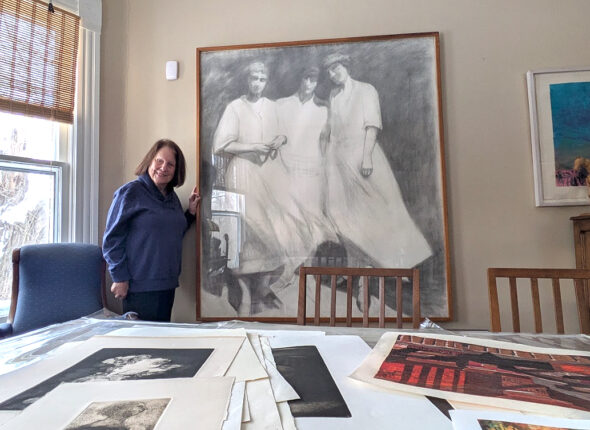
Artist Katherine Kadish in her Yellow Springs home; behind her is a large pencil drawing that depicts family members, including her aunt Christine, to whom she credits the inspiration to pursue a life devoted to creation. “Retrospective,” an exhibition featuring 65 years of Kadish’s work, is currently on display at The Winds Cafe. (Photo by Lauren “Chuck” Shows)
‘Retrospective’ to be on display at The Winds
- Published: February 6, 2026

A framed pencil drawing, several feet tall, hangs on the wall in Yellow Springs artist Katherine Kadish’s dining room. The drawing is animated by three women in white dresses, skirts billowing as if caught mid-gust. In a recent interview with the News, Kadish pointed to the drawing, which she made from a family photograph taken by her father of her grandmother, her aunt Anna, and her aunt Christine.
“I think if it hadn’t been for my aunt Christine, I might never have done art,” Kadish said.
The drawing hangs near a table covered in decades’ worth of color-soaked work, spread out as Kadish selected the 50 pieces that will hang in “Retrospective” — an exhibition of her work from 1960 to 2025 now on display at The Winds Café. The show includes etchings, wood block prints, oil paintings, pastels and monotypes.


Aunt Christine, Kadish said, was a public school teacher who taught art alongside other subjects, but never claimed the title of artist for herself.
“She couldn’t quite believe in herself as an artist,” Kadish said, describing the limits placed on women of her aunt’s generation. She stayed home, cared for family, tended a garden — and quietly made her own work. What inspired Kadish was not a particular style or technique, but the act of creation itself.
“It was just that she did it,” Kadish said.
Years later, when Kadish found some of Christine’s drawings in the cellar of her grandmother’s house, she noticed a resemblance.
“There were a few drawings that looked so much like something I might have done,” she said.
What Kadish has done over more than six decades has been prolific. The works chosen for “Retrospective,” the pieces covering her table and the art filling her home represent only a fraction of what she has produced, with much more stored in a downtown workspace.
Lifting aside a stack on the table, Kadish revealed several blue-toned prints featuring figures suspended in water — part of a long-running swimmer series.
“I’m not a very good swimmer,” Kadish said with a laugh. “But I love water. I just love it.”
Many of the swimmer series works are monotypes, a medium Kadish said she has favored since the early 1980s. Unlike etchings or wood block prints, which can be used to produce a series of prints, a monotype is created by painting or rolling ink onto a smooth plate, then running it through a press with damp paper, transferring a single image.
“Every monotype will be unique,” Kadish said.
There’s also a kind of countdown attached to each monotype: Once the ink is on the plate, the image must be pressed before the ink dries. Lithography ink, Kadish’s current medium — which she said she picked up from New York City-based master printer Lisa Mackie, with whom she’s worked to produce monotypes in recent years — can give artists a few hours of time to work. But no matter the ink or paint, the time available to finish a work is limited, creating a process that encourages the artist not to dither, and to accept wherever their hands might lead them.
“[Working in monotype] is interesting, because things happen beyond your control, you know?” Kadish said. “And I like that.”
Of the pieces chosen for her retrospective exhibition, about half are monotypes, which anchor the latter 40 years of her career, with every decade of her life as a working artist represented in the show. Over those decades, she said, figures blend with abstraction, then give way to it, then return again.
“It kind of goes back and forth,” Kadish said. “I’m always aware of the abstract qualities of something, but I don’t often set out to make an abstract work.”
There’s also a practicality to the high-color contrast and expressionistic quality that monotype and painting engender, Kadish said: When she was a teenager, she began developing what she would eventually learn was macular degeneration, a condition that limits her vision. Gradual vision loss meant eventually moving away from the fine lines of metal plate etchings and wood block engravings that proliferated in the first 20 years of her career. In that way, she said, macular degeneration has shaped, but not halted, her practice.
“I can see well enough,” she said. “And you have to get up close to create anyway.”
In “Blindsight 20/20,” a 2013 book by blind artist Busser Howell exploring blind and low-vision artists, Kadish described herself as “a visual person” and credited her continuing focus on color and form to a “very strong” visual memory.
“I can still remember pretty precisely where furniture was in the houses I lived in, what colors things were,” she said.
Kadish grew up in Pittsburgh and began attending Saturday art classes at the Carnegie Museum when she was 9. She earned a B.F.A. from Carnegie Mellon University and later an M.A. in art history from the University of Chicago. Though she has taught at Ohio State, Wright State, Wittenberg, the Cleveland Institute of Art and the Arrowmont School of Arts and Crafts in Tennessee, her focus has long been on maintaining a working studio practice. Her work has been exhibited internationally, and has found homes as nearby as the Columbus Museum of Art and as far away as the Victoria and Albert Museum in London.
In the 1960s, Kadish moved to New York state, where she served for a time as a curator of the print and slide collection in SUNY Binghamton’s art department. At SUNY, she formed a relationship with Charles Eldred, an artist and longtime associate professor of art. Kadish noted Eldred as a “big, big influence” on her own work.
“But you wouldn’t know by looking at [our work] that there was any influence,” she said with a laugh, pointing to a piece by Eldred in her living room: a brass sculpture, with rounded edges and a delicate, etched face.
“It wasn’t that his work was inspiring,” Kadish said. “It was that he believed in my work — his mind was open. That made a big difference.”
Travel has also shaped her work. Kadish cited time in England, Italy, Korea and nearly a year in China; she pulled out a sketchbook from a trip to New Mexico filled with roughed-in landscapes and handwritten color notes.
After years in New York state, Kadish moved to Yellow Springs in the 1980s with her then-husband, the late Robert Fogarty, longtime editor of The Antioch Review. While she has exhibited locally before, “Retrospective” marks the first time villagers can see the full arc of her career in one place.
As Kadish continued sifting through colorful piles of her life’s work on her dining room table, it became clear that the artist is not only prolific, but deeply admired. Skirting the edges of the room and conversation were Richard Vanstrum, whom she married in 2024 after a long friendship that began 30 years ago in Arrowmont, where Kadish taught print-making; and Sally Brown, a friend who has worked as Kadish’s assistant since 2009.
Both spoke of her art with high regard, pointing to a shared favorite piece: 1993’s “Carpenters,” a dark-hued pastel work depicting three figures hard at work, the viewer’s perspective close to their faces and their toil. “Carpenters” commands a special place within the exhibition at The Winds: Vanstrum hung it on a wall in Kadish’s favorite quiet corner of the restaurant.
Though snow was piled high on the ground as her interview with the News wound down, Kadish was looking forward to the spring, when she aims to begin holding monotype classes in a studio space behind her home.
“If you feel like messing around with monotypes, come out,” she said.
When this reporter expressed skepticism about her own artistic abilities, Kadish waved a hand in friendly dismissal.
“Don’t worry about that,” she said. “If you let that get in the way, you’ll never do anything.”
A reception for “Retrospective” will be held Sunday, Feb. 8, 4–6 p.m.
The Yellow Springs News encourages respectful discussion of this article.
You must login to post a comment.
Don't have a login? Register for a free YSNews.com account.




No comments yet for this article.