




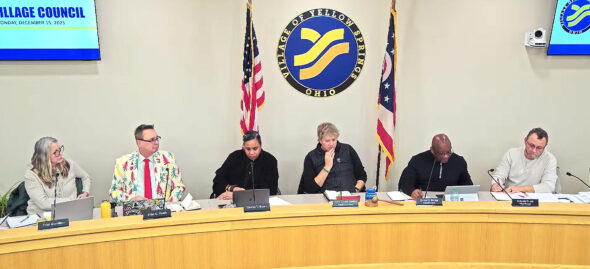
Present for the final Council meeting of the year were, from left, Trish Gustafson, Brian Housh, Carmen Brown, Gavin DeVore Leonard, Kevin Stokes and Village Manager Johnnie Burns. (Video still)
Village Council approves tax abatement for apartment developer
- Published: December 23, 2025

At the group’s final meeting of the year, Monday, Dec. 15, Village Council turned their attention again to the plans to build over 100 apartment units on two sites affiliated with the Antioch College campus.
Columbus-based real estate developer Windsor Companies intends to demolish the college’s former student union — which the developer purchased last summer for $500,000 — and in its place on the 2.16-acre site, build two three-story apartment buildings, with 48 rental units in each.
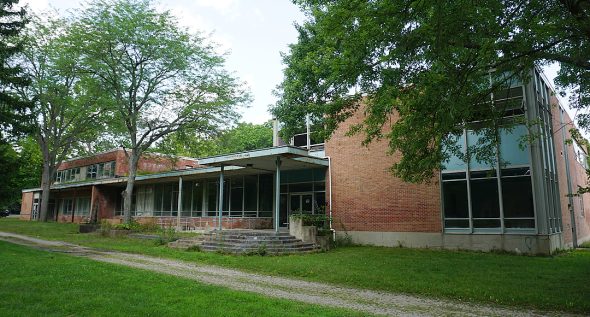
A block away, Windsor also seeks to purchase the Charles F. Kettering building from Antioch and redevelop it to accommodate 43 rental units for persons 55 and older.
To actualize those plans, Windsor representatives have been working with Village staff over the last several months to negotiate a tax abatement agreement — one that Windsor representatives claim would help offset development costs and make the project more financeable.
At Monday’s Council meeting, Windsor sought Council’s approval for two separate 15-year, 75% tax abatements on the former student union site and the Kettering building.
These abatements will exempt Windsor from paying 75% of all real property taxes generated from both properties — taxes that would otherwise have been collected in full by local jurisdictions, including the Village of Yellow Springs, Miami Township, the Yellow Springs Exempted School District and the General Health District.
By a unanimous vote of 5–0 on both pieces of legislation — one for the student union and one for the Kettering building — Council agreed to issue Windsor the requested abatement of their future property taxes.
According to Windsor acquisitions and development partner Erik Alfieri, all Windsor’s plans to build apartments around Antioch’s campus would have been sunk without the temporary and partial relief from property taxes.
“Without the contemplated abatement,” Alfieri told Council before its vote, “cash flow would be hampered or reduced to a point at which securing that construction financing would be a challenge, such that it would be difficult to effectuate the project.”
He later added: “Without this incentive structure, the project probably doesn’t happen based on all the facts that we know today, based on all our underwriting, based on our conversations with relationship lenders, based on all the studies we’ve done on rent levels in the area.”
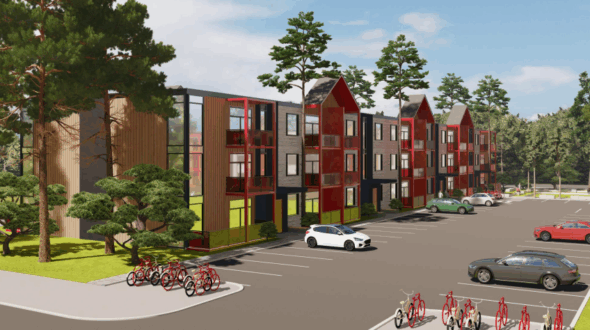
Columbus-based Windsor Companies aims to demolish the derelict former Student Union at
Antioch, and in its place on the 2.16-acre site, build two three-story apartment buildings. A rendering of one is shown here. (Submitted photo)
Bricker Graydon public finance attorney Tyler Bridge reminded Council members at the outset of the meeting that though Windsor won’t be paying the full amount on property taxes for the first 15 years of their projects’ “lifecycles,” as he put it, those properties will still generate revenue for local coffers.
“It’s worth bearing in mind that these properties were owned by Antioch College, and as such, those properties were exempt from paying real property tax all throughout that ownership period,” Bridge said. “When we have a private development, those real property taxes would increase because of the construction or rehabilitation of new structures.”
In other words, Windsor will pay 25% of real property taxes for the first 15 years of their planned apartments — more than the 0% that Antioch had been paying on those buildings, as allowed by Ohio law under the college’s educational tax-exempt status. By year 16, Windsor will be taxed like any other property owner.
Alfieri also told Council that beyond the tangible tax revenue Windsor’s project will generate, the apartments could be “a substantial driver for economic growth for the whole community.”
“There are a ton of folks who are desperate to live here,” he said. “They don’t have an option to do so today, and these apartments are intended to be an option. If they come to the village as new residents, they will also generate new income tax for the village, they will be patrons of local shops and businesses.”
Council member Carmen Brown added that the future apartments could allow existing residents — “People who have called this place their home for a really long time,” she said — to not be forced to move away from Yellow Springs.
The tax abatements issued to Windsor on Monday were bundled in legislation that specifically authorized the Village manager to enter into a community reinvestment area, or CRA, agreement with Windsor for the two properties.
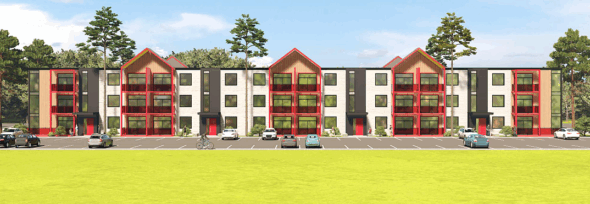
Columbus-based real estate developer Windsor Companies’ newest plan for apartments at the site of the former Antioch College Student Union entails building a two three-story apartment complexes composed of 48 units each. (Rendering courtesy of Windsor Companies)
As previously reported, a CRA is a property tax reduction tool and economic development incentive overseen by the Ohio Department of Development, and can be applied by county and local governments, with conditions that can be individually tailored on a case-by-case basis.
At a Council meeting last month, the group approved an ordinance to create a villagewide CRA — one that blankets the entirety of Yellow Springs’ municipal limits, and one that gives Village Council the sole ability to issue tax abatements to developers as they see fit, and by majority vote.
“[CRAs] are a mechanism that you, Council, can use to grant tax abatements,” Village Solicitor Amy Blankenship reminded Council ahead of their decision on Monday. “For an applicant to receive an abatement in the village, all those requests will come through Council. None can be approved by staff. Every abatement has to be approved by contract.”
While all Council members were amenable to granting Windsor the two tax abatements — with all five members ultimately voting “yes” — there were some sticking points.
Council member Brian Housh insisted that Windsor follow through on some commitments that representatives of the development company had previously made at past Planning Commission and Village Council meetings — namely to reserve 15 rental units in the student union replacement buildings, and seven rental units in the Kettering remodel as “permanently affordable.”
While Windsor’s CRA application included keeping “approximately” that amount of units affordable — as defined as housing for households earning 80% or less of the area median income — the CRA agreement eschewed the permanence factor. By year 16, or after the tax abatement expires, Windsor could, ostensibly, bring all 139 total rental units to market-rate prices.
With plans to demolish the site, Columbus-based Windsor Companies purchased the Antioch College Student Union for $500,000 last year. The developer plans to erect efficiency and one- and two-bedroom apartments in its place. (Photo by Reilly Dixon)
“I thought we were all on the same page, that we were talking about permanent affordability,” Housh said.
As previously reported in the News, Planning Commission, at the group’s June 16 meeting, recommended Council’s approval on Windsor’s preliminary development plan, as well as the developer’s request to rezone the former student union property to a PUD, or planned unit development, with the condition that “a minimum of 15% of dwelling units are to be permanently affordable.” At Council’s July 7 meeting, Council members voted unanimously to follow Planning Commission’s recommendation and approved Windsor’s preliminary plan and rezoning request.
Alfieri said at Monday’s Council meeting that the exclusion of “permanent affordability” in the CRA agreement was not Windsor’s attempt to renege on those earlier agreements, but was the result of a lack of understanding between the developer and the Village.
“What’s the mechanism for permanent affordability? How is it enforced?” Alfieri asked Council. “We didn’t settle on any mechanism. That’s the point I want everyone to be clear on. That’s the issue — not our desire to comply with the intent of our discussion. We take our commitments seriously.”
At the same time, Alfieri admitted that he and his Windsor colleagues do tend to avoid development agreements that allude to permanency.
“It’s difficult to foresee what the needs of any community are going to be in 20, 30, 40 years down the road,” he said. “What some of these permanent structures tied to land use do over time is have unintended consequences that can lead to blight. … If you have regulations that are tied to the land in perpetuity, it can be difficult to catalyze redevelopment thereafter.”
After some back-and-forth discussion, Solicitor Blankenship told Council members that the group will have the legislative latitude to require conditions of permanent affordability for some of their units when Windsor will later return for approval for the final plat approval for their PUD plans.
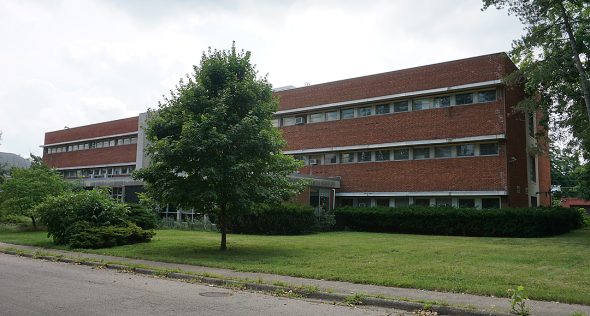
The Charles F. Kettering Building, at 150 E. South College St., built in 1950, was home to classrooms, administration and faculty offices, as well as scientific research laboratories. Now, it houses 91.3 WYSO. Currently under contract, Windsor plans to turn this building into 55-and-older residential apartments. (Photo by Reilly Dixon)
Following Council’s approval of the preliminary plans on July 7, Windsor was granted one year to present to the Village their final site plans — incorporating results from traffic, parking and pedestrian impact studies; state requirements for sound, accessibility and sustainability; architectural reviews; and engineering recommendations.
“So, there will be a PUD agreement that is going to be entered into between Council and the developer,” Blankenship explained. “That’s when we figure out that mechanism for permanent affordability.”
Just a minute ahead of the final vote on the two CRA/tax abatement resolutions, Housh raised one more concern: the previously broached possibility of reopening the closed and Antioch-owned section of road that used to be East North College Street.
Both supporters and opponents to the proposed Windsor apartments have stated that the former right-of-way needs to be reopened to the public to help mitigate any traffic congestion the future apartments may cause.
“I know we’ve had some issues with Antioch College agreeing to return it to the Village, I hear Windsor saying it’s not on the table, and I know [Village Manager] Johnnie Burns is stuck in the middle,” Housh said. “Both Council and neighbors have said this is a way to make the project a lot more palatable.”
“Legally, we can’t require a developer to acquire a right-of-way,” contended Blankenship.
“Well, I see it slipping away, which is really disappointing,” Housh responded. “I’m still going to vote in favor of this because we need the housing, and I’d rather see people get something than nothing. I just can’t believe we can’t get it together on this.”
Additional coverage ofon the Monday, Dec. 15, Village Council meeting will appear in the Friday, Jan. 2, 2026, issue of the News.
The next Village Council meeting will be Monday, Jan. 5, at 6 p.m. in Council Chambers, on the second floor of the John Bryan Community Center.
The Yellow Springs News encourages respectful discussion of this article.
You must login to post a comment.
Don't have a login? Register for a free YSNews.com account.





No comments yet for this article.